
Your vocation, our passion

We are your one stop creative agency providing
Business IT Services.
Top Notch Digital Marketing Agency that drives revenue
and propel your business to new heights.
We create value for industries like Fin-tech |
Healthcare | Ed-tech | Beauty | Travel | E-commerce
and more.
Shopify vs WooCommerce in 2026: Which Platform Is Better for Your Business?

Shopify and WooCommerce are both leading ecommerce platforms, but they serve different business needs. Shopify is best for businesses that want a fully managed solution with built-in hosting, security, and minimal technical maintenance. WooCommerce is ideal for businesses that need complete ownership, advanced customization, and the flexibility of WordPress. If your priority is launching quickly, Shopify is usually the better choice. If long-term customization and control are more important, WooCommerce is often the stronger option.
Why Choosing the Right Ecommerce Platform Matters
Choosing between Shopify and WooCommerce has become more important than ever in 2026. Shopify continues to dominate as a fully managed ecommerce platform trusted by businesses that value speed, security, and ease of use. WooCommerce, built on WordPress, remains the preferred choice for companies that need complete ownership, advanced customization, and powerful content marketing capabilities.
The challenge is that neither platform is universally better. The right choice depends on your business model, technical resources, growth plans, and long-term goals. A startup launching its first online store may prioritize simplicity, while an established business with complex workflows may need the flexibility that WooCommerce provides.
In this guide, we'll compare Shopify and WooCommerce across pricing, SEO, performance, customization, scalability, security, and total cost of ownership so you can confidently choose the platform that best supports your business.
What Is Shopify?
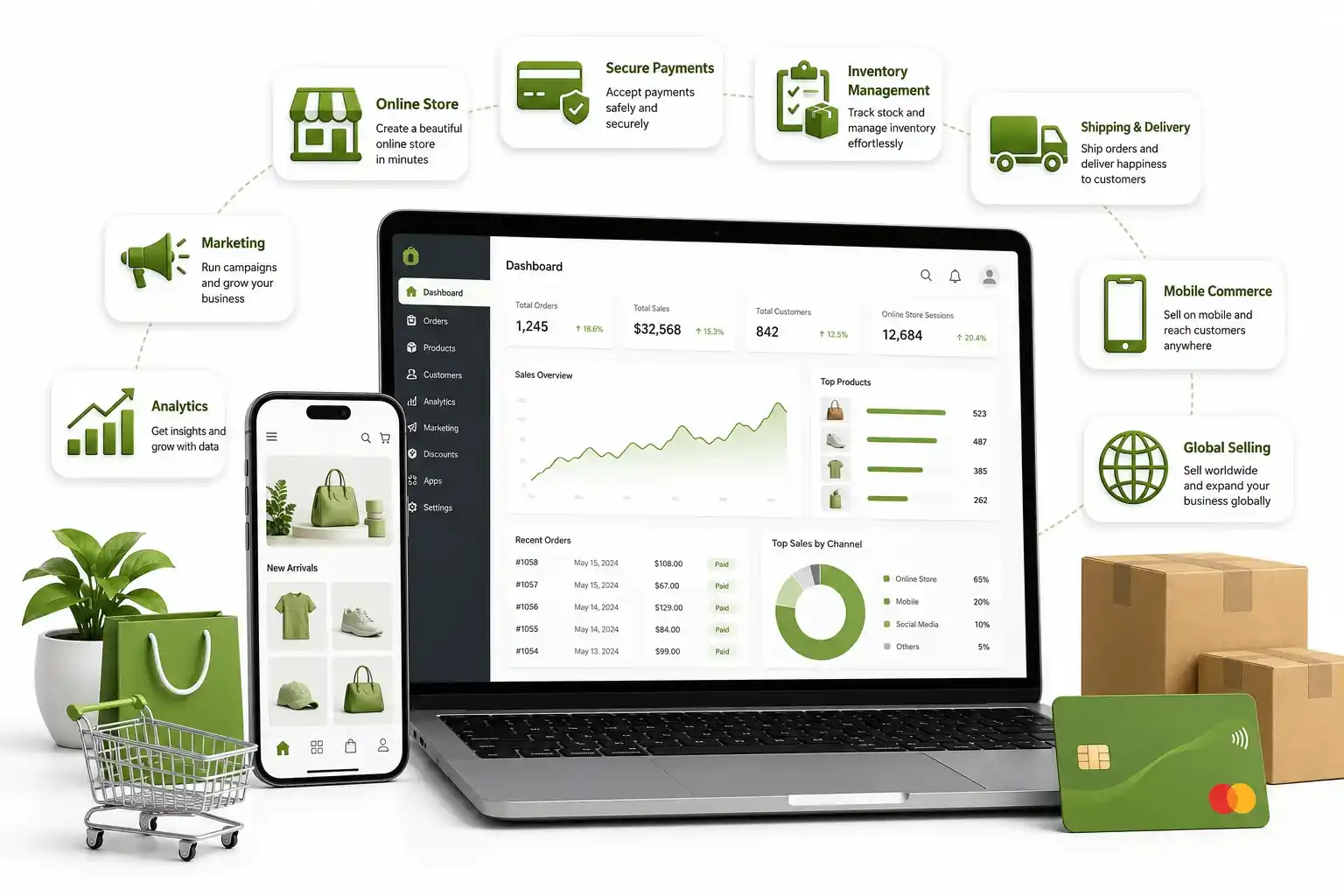
Shopify is a fully hosted ecommerce platform designed to simplify online store management.
It combines hosting, security, software updates, and ecommerce tools into one subscription.
Business owners can launch stores quickly without managing servers or complex technical infrastructure.
Because Shopify manages the technical infrastructure, businesses spend less time handling software updates, server management, backups, and security patches. This makes it particularly attractive for teams without dedicated web developers or IT staff.
Key Shopify Features
- Fully hosted platform
- Built-in security
- Secure checkout
- Mobile-responsive themes
- Large app marketplace
- Multi-channel selling
- Inventory management
- Integrated payment options
Advantages of Shopify
Key advantages include:
- Fast setup
- Automatic software updates
- Reliable hosting
- Excellent uptime
- Strong security
- Beginner-friendly interface
- Extensive app ecosystem
What Is WooCommerce?
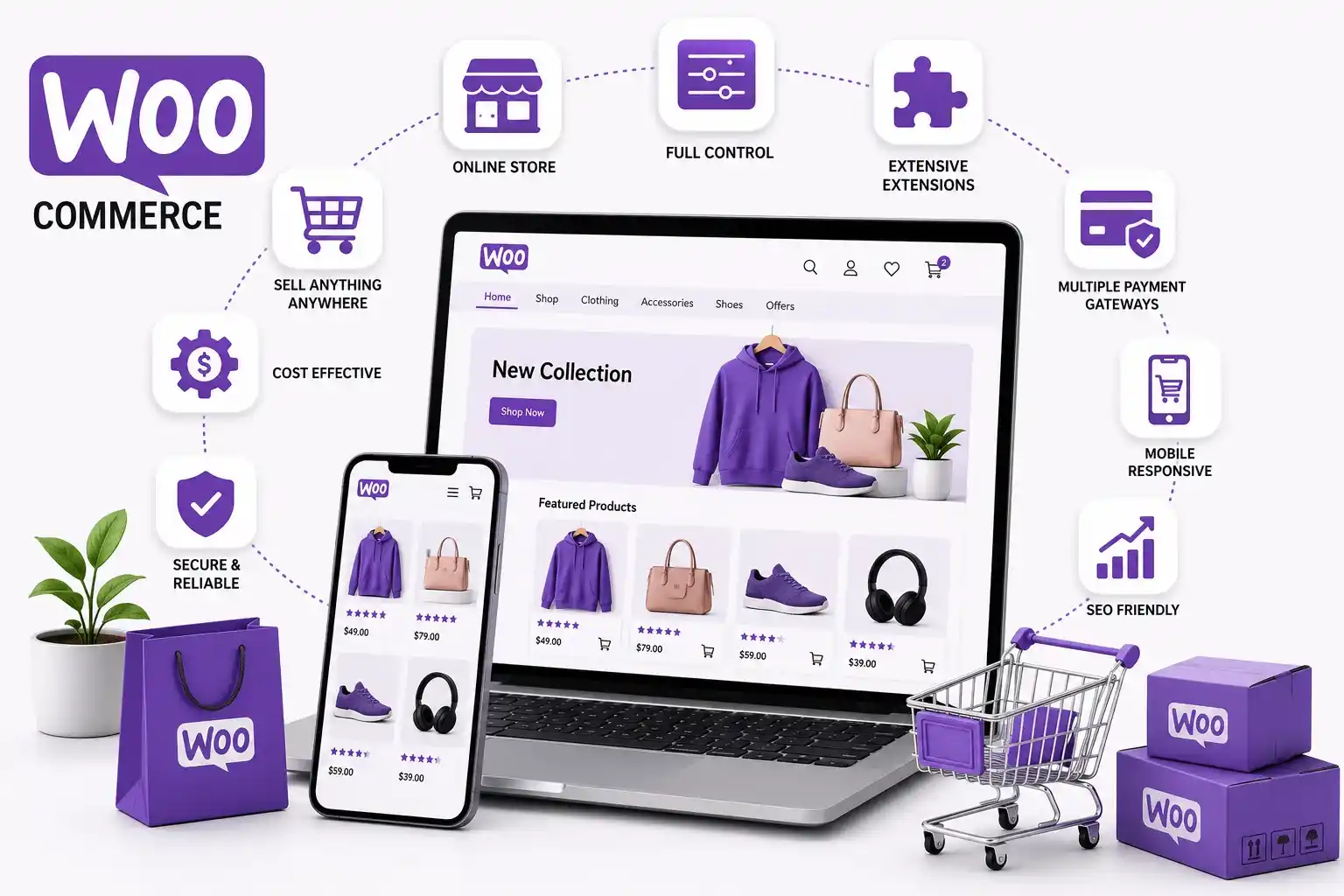
WooCommerce is an open-source ecommerce plugin built for WordPress.
Unlike Shopify, WooCommerce gives businesses complete ownership and control over their ecommerce websites.
It supports nearly unlimited customization, making it suitable for businesses with unique workflows and advanced functionality requirements.
WooCommerce Features
WooCommerce supports:
- Unlimited products
- Flexible product types
- Custom checkout experiences
- Advanced shipping rules
- Extensive plugin ecosystem
- Third-party integrations
- Complete design flexibility
- Full access to source code
This flexibility makes WooCommerce one of the most customizable ecommerce platforms available.
Advantages of WooCommerce
Complete Ownership
You control your hosting, website files, and data.
Unlimited Customization
Every aspect of the website can be customized.
Flexible Integrations
WooCommerce integrates with thousands of business tools.
Content Marketing Strength
Because WooCommerce runs on WordPress, businesses benefit from powerful content management capabilities.
Cost Flexibility
Businesses can choose hosting, plugins, and services that fit their budget.
Shopify vs WooCommerce: At a Glance
| Feature | Shopify | WooCommerce |
|---|---|---|
| Hosting | Included | Self-hosted |
| Ease of Use | Excellent | Moderate |
| Customization | High | Unlimited |
| Technical Control | Moderate | Complete |
| Maintenance | Managed | Self-managed |
| Scalability | Excellent | Excellent |
| Ownership | Platform-based | Full ownership |
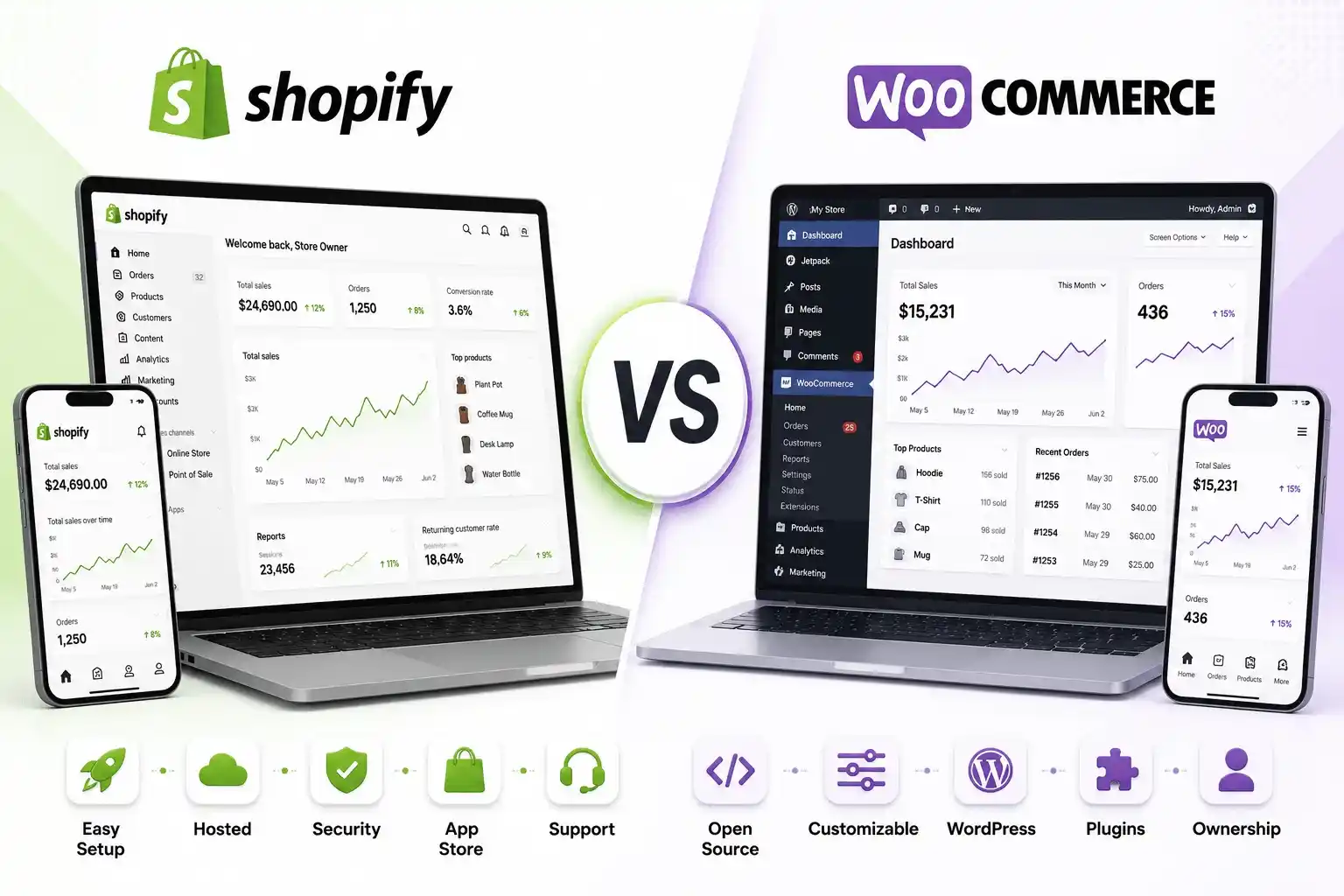
At a high level, Shopify focuses on simplicity and managed infrastructure, while WooCommerce prioritizes flexibility and ownership.
Another important difference is ownership. Shopify operates as a hosted software platform, while WooCommerce gives businesses full ownership of their website files, database, and hosting environment. For companies with strict compliance requirements or highly customized workflows, this distinction can be an important decision factor.
Who Should Choose Shopify vs WooCommerce?

Shopify is generally the better choice for businesses that want to focus on selling products rather than managing website infrastructure and ongoing technical maintenance.
Choose Shopify if you:
- Want to launch quickly
- Prefer managed hosting and security
- Have limited technical expertise
- Run a startup or small business
- Sell directly to consumers
- Need minimal maintenance
WooCommerce is ideal for businesses that value flexibility, content marketing, and complete control over every aspect of their ecommerce website.
Choose WooCommerce if you:
- Already use WordPress
- Need complete ownership of your website
- Want extensive customization
- Sell complex product catalogs
- Require custom business workflows
- Plan advanced integrations
- Rely heavily on content marketing
Shopify vs WooCommerce Pricing and Total Cost
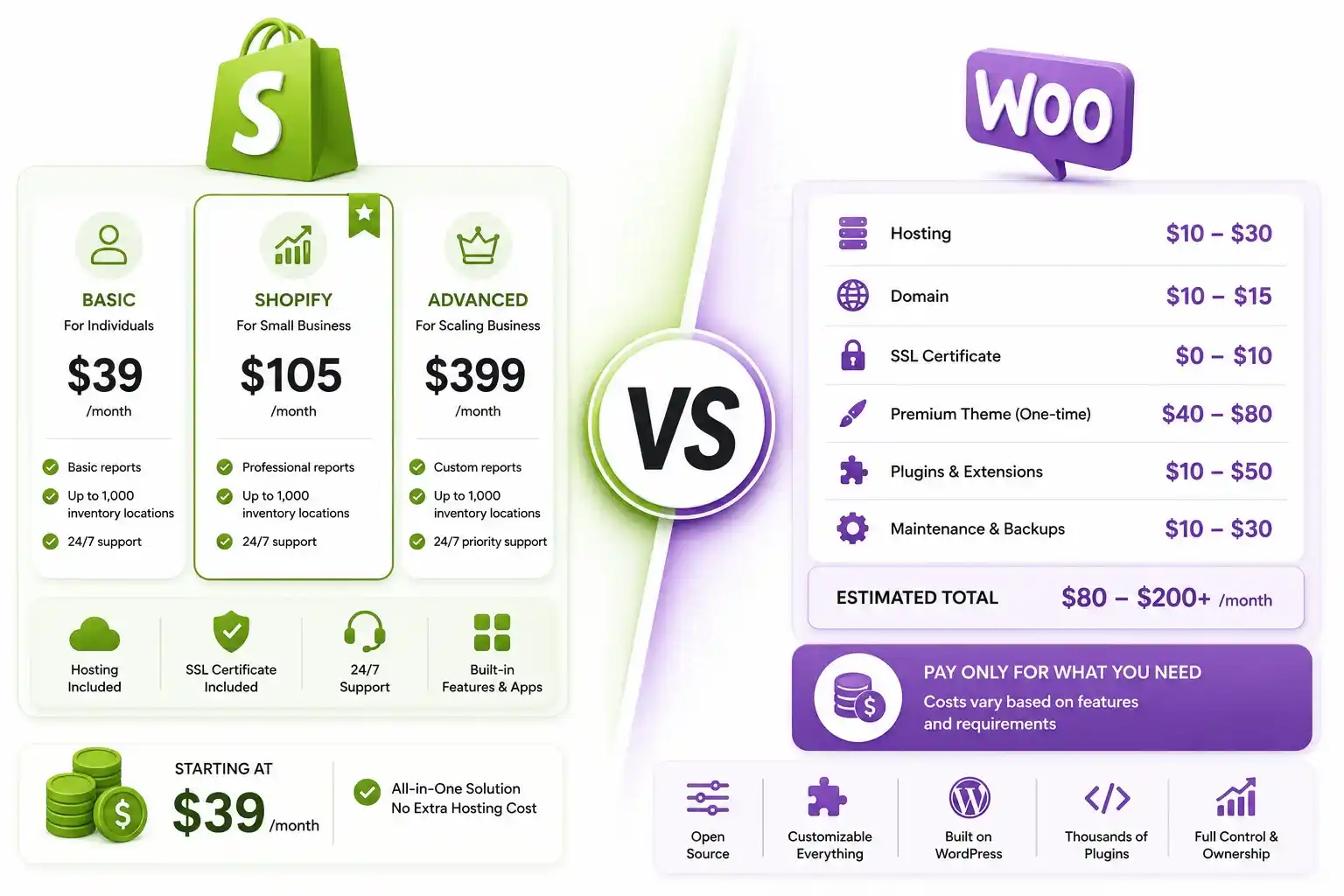
Comparing monthly pricing alone can be misleading. Shopify bundles hosting, security, and platform maintenance into its subscription, while WooCommerce requires businesses to purchase and manage these separately. Evaluating the total cost of ownership provides a more accurate comparison than looking only at the initial price.
| Cost Factor | Shopify | WooCommerce |
|---|---|---|
| Platform License | Monthly subscription | Free |
| Hosting | Included | Separate |
| SSL Certificate | Included | Usually included with hosting |
| Security | Managed | Business responsibility |
| Premium Themes | Optional | Optional |
| Plugins/Extensions | Paid and free | Paid and free |
| Maintenance | Included | Self-managed or outsourced |
Businesses should evaluate the total cost of ownership, not only the starting price.
Hidden Costs to Consider
Many platform comparisons overlook ongoing operational costs.
Before making your decision, consider:
Shopify Hidden Costs
- Premium apps
- Transaction fees (depending on payment gateway)
- Advanced plan upgrades
- Custom development
WooCommerce Hidden Costs
- Premium plugins
- Managed hosting
- Security tools
- Performance optimization
- Technical maintenance
Understanding these expenses helps businesses budget more accurately.
Shopify typically offers more predictable monthly expenses, while WooCommerce provides greater flexibility but can become more expensive depending on hosting, premium plugins, developer support, and ongoing maintenance. Businesses should evaluate the total cost over several years rather than comparing entry-level pricing alone.
Shopify vs WooCommerce for SEO
Search visibility plays a major role in ecommerce success.
Both platforms can rank well in search engines when implemented correctly.
However, they approach SEO differently.
Shopify includes many built-in SEO features that simplify optimization.
WooCommerce, powered by WordPress, offers greater flexibility through plugins and complete control over technical SEO.
| SEO Factor | Shopify | WooCommerce |
|---|---|---|
| Metadata Management | Excellent | Excellent |
| URL Customization | Good | Excellent |
| Technical SEO Control | Moderate | High |
| Structured Data | Good | Highly customizable |
| Blogging Capabilities | Good | Excellent |
| Plugin Ecosystem | Moderate | Extensive |
Businesses seeking advanced optimization often combine WooCommerce with professional ecommerce SEO services.
Likewise, businesses using Shopify benefit from specialized Shopify SEO services that improve technical performance, content optimization, and search visibility.
For most businesses, content quality, technical optimization, site speed, and backlink authority have a greater impact on rankings than the ecommerce platform itself.
Shopify vs WooCommerce Performance
WooCommerce performance depends largely on how the store is built, hosted, and optimized. A well-optimized WooCommerce store running on quality hosting can achieve excellent Core Web Vitals. However, excessive plugins, poorly coded themes, or low-quality hosting can reduce performance. Shopify generally delivers more consistent out-of-the-box performance because hosting, caching, and infrastructure are managed by the platform.
Hosting quality is one of the biggest factors affecting WooCommerce performance. Since WooCommerce is self-hosted, website speed depends on the hosting provider, server configuration, database optimization, and caching setup. Businesses using managed WordPress hosting, a content delivery network (CDN), and optimized caching can achieve loading speeds comparable to Shopify. In contrast, Shopify automatically manages these infrastructure components, reducing the need for ongoing technical optimization.
Website performance is also influenced by how the store is built. Large image files, unnecessary plugins, poorly coded themes, and excessive third-party scripts can slow down both Shopify and WooCommerce stores. Optimizing images, minimizing unused apps or plugins, enabling browser caching, and regularly monitoring Core Web Vitals help maintain a fast and responsive shopping experience regardless of the platform.
In practice, both platforms can deliver excellent performance when properly optimized. Shopify generally requires less technical management because its infrastructure is fully managed, while WooCommerce provides greater flexibility for businesses that want complete control over hosting and performance optimization. The better choice depends on whether your priority is convenience or maximum customization.
Shopify vs WooCommerce Customization and Design

Customization requirements vary significantly between businesses. While both Shopify and WooCommerce allow businesses to create professional ecommerce websites, they differ in how much control they provide over design, user experience, and functionality. Shopify emphasizes ease of customization with professionally designed themes and apps, whereas WooCommerce offers virtually unlimited flexibility because developers have full access to the website code.
| Feature | Shopify | WooCommerce |
|---|---|---|
| Theme Customization | Excellent | Excellent |
| Source Code Access | Limited | Complete |
| Checkout Customization | Moderate | Extensive |
| Third-Party Integrations | Excellent | Excellent |
| Custom Business Logic | Good | Unlimited |
Design Flexibility
Shopify makes it easy to launch a visually appealing online store using professionally designed themes that require minimal technical knowledge. Businesses can customize layouts, colors, typography, and branding while maintaining a consistent user experience. WooCommerce offers greater design freedom because businesses can use virtually any WordPress theme or build completely custom storefronts. Developers can also use popular page builders such as Elementor or Gutenberg to create highly customized layouts.
User Experience
User experience depends less on the platform itself and more on how the website is designed and optimized. Both Shopify and WooCommerce can deliver fast, mobile-friendly ecommerce experiences when implemented correctly. Shopify provides a standardized checkout experience that is optimized for usability, while WooCommerce allows businesses to customize nearly every stage of the customer journey, including navigation, product pages, and checkout flows.
Which Platform Is Better for Design?
Businesses that want professionally designed stores with minimal effort often prefer Shopify because its themes and built-in tools simplify design decisions. Businesses requiring unique branding, highly customized customer journeys, or specialized user experiences usually benefit more from WooCommerce, where developers have complete control over every aspect of the storefront.
Shopify vs WooCommerce Scalability
Growth requires a platform that supports increasing traffic, larger product catalogs, and expanding business operations.
Both Shopify and WooCommerce can scale successfully.
The difference lies in how scaling is managed.
Shopify
Scaling infrastructure is largely handled by Shopify.
Businesses spend less time managing servers and performance.
WooCommerce
Businesses control hosting and infrastructure.
This offers greater flexibility but also requires technical expertise or professional management.
| Growth Area | Shopify | WooCommerce |
|---|---|---|
| High Traffic | Excellent | Excellent |
| Large Product Catalog | Excellent | Excellent |
| Multi-store Management | Good | Excellent |
| Enterprise Integrations | Excellent | Excellent |
| Infrastructure Control | Limited | Complete |
Scalability depends on more than the ecommerce platform alone. Businesses should also consider order volume, product catalog size, international expansion, third-party integrations, and operational complexity. Shopify automatically scales its infrastructure during high-traffic events, making it a popular choice for fast-growing brands that prefer not to manage servers. WooCommerce, on the other hand, gives businesses full control over hosting resources, allowing them to upgrade servers, implement advanced caching, or optimize databases as demand increases.
Businesses expecting seasonal traffic spikes, multiple storefronts, or enterprise-level integrations should evaluate not only current requirements but also how their platform will support future growth. In many cases, Shopify reduces operational overhead, while WooCommerce offers greater flexibility for organizations with experienced development teams.
Shopify vs WooCommerce Security
Customer trust depends on website security.
Shopify manages most security responsibilities automatically.
Shopify includes:
- PCI compliance
- SSL certificates
- Platform updates
- Infrastructure security
WooCommerce requires businesses to manage:
- Hosting security
- Plugin updates
- Firewall configuration
- Malware protection
- Website backups
Professional development teams help maintain secure WooCommerce environments through ongoing monitoring and maintenance.
For businesses without an in-house technical team, Shopify's managed security significantly reduces operational overhead. WooCommerce offers greater control, but businesses are responsible for monitoring vulnerabilities, updating plugins, configuring backups, and maintaining secure hosting environments. The better choice depends on whether your organization prioritizes convenience or complete control.
Regardless of the platform you choose, regular monitoring, secure payment processing, strong passwords, and ongoing maintenance remain essential for protecting customer data and maintaining trust.
When Does Shopify Plus Make Sense?
Shopify Plus is not simply a higher-priced Shopify plan. It is designed for high-growth and enterprise businesses that require advanced automation, customizable checkout experiences, dedicated account support, and the ability to manage multiple storefronts at scale. Most startups and small businesses will not need these enterprise capabilities.
- Custom checkout experiences
- B2B ecommerce
- Automation workflows
- Multi-store management
- Enterprise integrations
- International selling strategies
Shopify Plus is generally recommended for businesses processing high sales volumes, operating multiple storefronts, or requiring advanced automation and enterprise integrations. Smaller businesses rarely need its additional capabilities.
Decision Framework: Which Platform Should You Choose?
There is no universal winner in the Shopify vs WooCommerce debate.
The best platform depends on your business model, technical resources, growth strategy, and long-term objectives.
Use this framework to make a confident decision.
| Business Need | Recommended Platform |
|---|---|
| Launch quickly with minimal maintenance | Shopify |
| Complete ownership and flexibility | WooCommerce |
| Existing WordPress website | WooCommerce |
| Non-technical business owners | Shopify |
| Highly customized ecommerce workflows | WooCommerce |
| Enterprise ecommerce with managed infrastructure | Shopify Plus |
| Content-driven ecommerce strategy | WooCommerce |
| Fast scaling with less technical management | Shopify |
The goal is to choose the platform that supports your business over the next five years—not just the next five months.
While platform selection is important, long-term ecommerce success depends more on product quality, user experience, technical SEO, marketing strategy, and ongoing optimization than on the ecommerce platform itself. Businesses that invest in these areas typically outperform competitors regardless of whether they choose Shopify or WooCommerce.
Which Platform Is Better by Business Type?
Different businesses have different priorities.
| Business Type | Recommended Platform | Why |
|---|---|---|
| Startup | Shopify | Faster launch and lower technical complexity |
| Small Business | Shopify | Easy management and predictable maintenance |
| Growing Brand | Shopify or WooCommerce | Depends on customization needs |
| Content-Driven Business | WooCommerce | Superior content management with WordPress |
| Large Ecommerce Store | WooCommerce | Greater flexibility and ownership |
| Enterprise Business | Shopify Plus or WooCommerce | Based on operational requirements and integrations |
| B2B Ecommerce | Shopify Plus or WooCommerce | Advanced workflows and scalability |
| International Ecommerce | Either | Both support global expansion when properly implemented |
This comparison highlights that platform choice should align with business goals rather than popularity.
Final Verdict: Shopify or WooCommerce?
Shopify and WooCommerce are both capable of supporting successful ecommerce businesses, but they solve different challenges. Shopify is often the better option for businesses that want predictable maintenance, fast deployment, and managed infrastructure. WooCommerce is better suited to organizations that require greater flexibility, complete ownership, and highly customized functionality.
Rather than choosing the platform with the longest feature list, evaluate how each solution aligns with your business goals, technical resources, content strategy, and future growth plans. Making the right decision now can reduce future migration costs and create a stronger foundation for long-term ecommerce success.
If simplicity, predictable maintenance, and faster deployment are your priorities, Shopify is likely the better choice. If your business values complete ownership, advanced customization, and long-term flexibility, WooCommerce remains one of the most flexible ecommerce platforms available.
Whether you choose Shopify or WooCommerce, you have a reliable partner to ease your development. Contact the Maxcode team now for a free consultation and start your E-commerce journey.
Frequently Asked Questions
1. Which is better, Shopify or WooCommerce?
Both platforms are excellent. Shopify is ideal for businesses seeking simplicity and managed hosting, while WooCommerce is better for businesses requiring complete customization and ownership.
2. Is WooCommerce cheaper than Shopify?
WooCommerce has no licensing fee, but businesses must pay for hosting, security, maintenance, and premium plugins. Shopify has predictable monthly pricing but may require paid apps as your store grows.
3. Which platform is better for SEO?
Both platforms can achieve strong rankings. WooCommerce offers greater technical flexibility, while Shopify provides built-in SEO features that are easy to manage. Professional Shopify SEO services or ecommerce SEO services can maximize results on either platform.
4. Which platform is easier for beginners?
Shopify is generally easier because hosting, security, updates, and maintenance are managed automatically.
5. Can WooCommerce handle large ecommerce stores?
Yes. With proper hosting and professional WooCommerce development services, WooCommerce can support large product catalogs, high traffic, and enterprise-level functionality.
6. What is Shopify Plus?
Shopify Plus is Shopify's enterprise solution designed for high-growth businesses that need advanced customization, automation, and enterprise integrations.
7. When should I hire a Shopify development company?
Consider hiring a Shopify development company when you need custom themes, advanced functionality, integrations, store optimization, or migration assistance.
8. Is WooCommerce good for content marketing?
Yes. Since WooCommerce is built on WordPress, it provides outstanding blogging and content management capabilities, making it an excellent choice for SEO-driven businesses.
9. Can I migrate from WooCommerce to Shopify or vice versa?
Yes. Professional developers can migrate products, customer data, orders, and content while minimizing disruption to your business.
10. Which platform offers better long-term scalability?
Both platforms scale effectively. Shopify simplifies infrastructure management, while WooCommerce provides greater flexibility and control. The right option depends on your business requirements and technical resources.
Author:

By day, Naina Veerwani wrangles tech trends and leads the charge as CXO at Maxcode IT Solutions Pvt. Ltd with her eight years of industry experience. By night (or whenever inspiration strikes!), she transforms into a content-crafting ninja, crafting insightful blog posts to feed your tech knowledge appetite. When she's not wielding words, you can find her obsessing over the latest tech breakthroughs and social media trends or sometimes over tasty food.