
Your vocation, our passion
We are your one stop creative agency providing
Business IT Services.
Top Notch Digital Marketing Agency that drives revenue
and propel your business to new heights.
We create value for industries like Fin-tech |
Healthcare | Ed-tech | Beauty | Travel | E-commerce
and more.
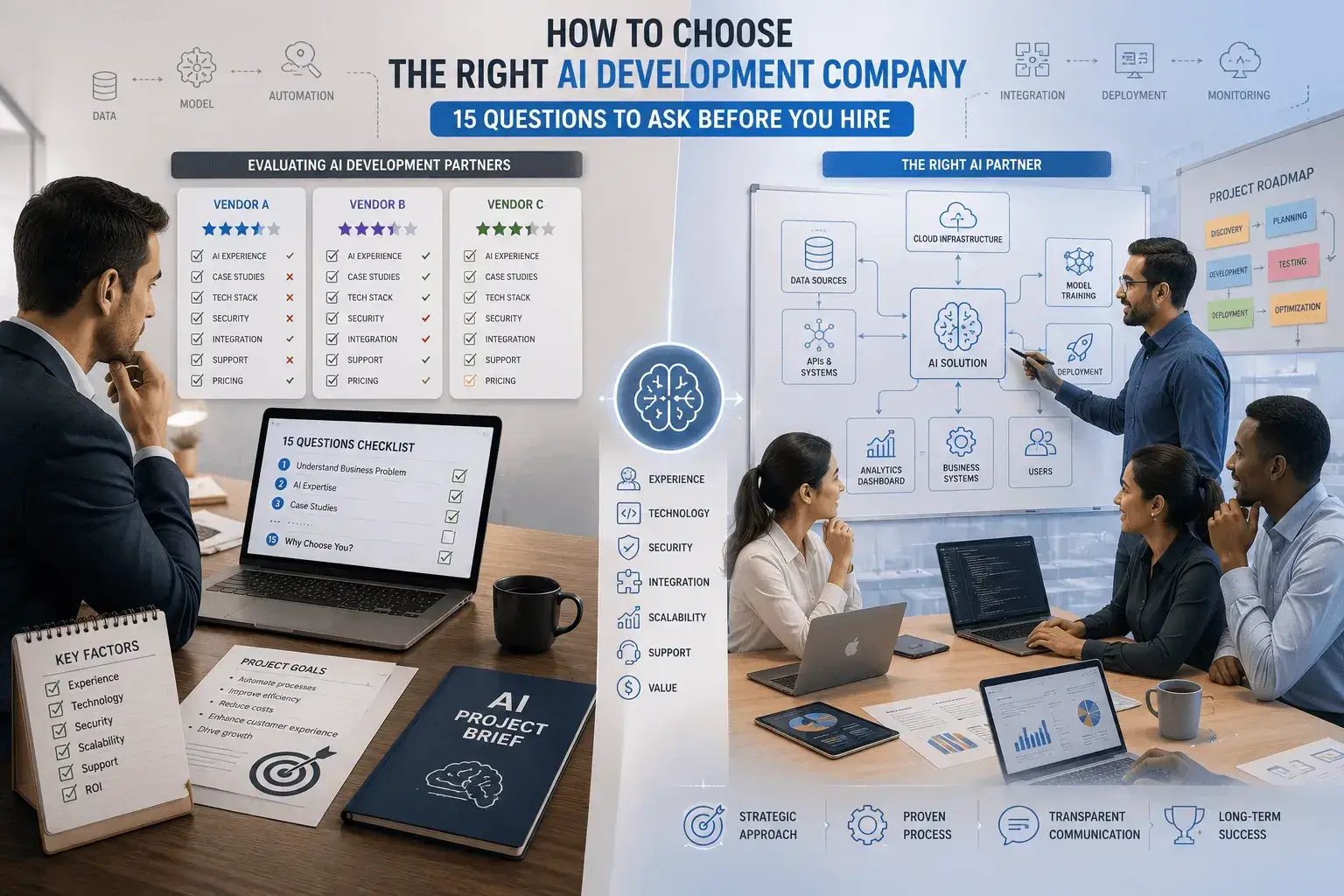
How to Choose the Right AI Development Company: 15 Questions to Ask Before You Hire
Choosing the right AI development company means selecting a partner with proven AI expertise, a clear development process, strong security practices, and experience integrating AI into real business workflows. Evaluating these factors before hiring helps reduce implementation risks and improves the likelihood of long-term project success.
Why Choosing the Right AI Development Company Matters
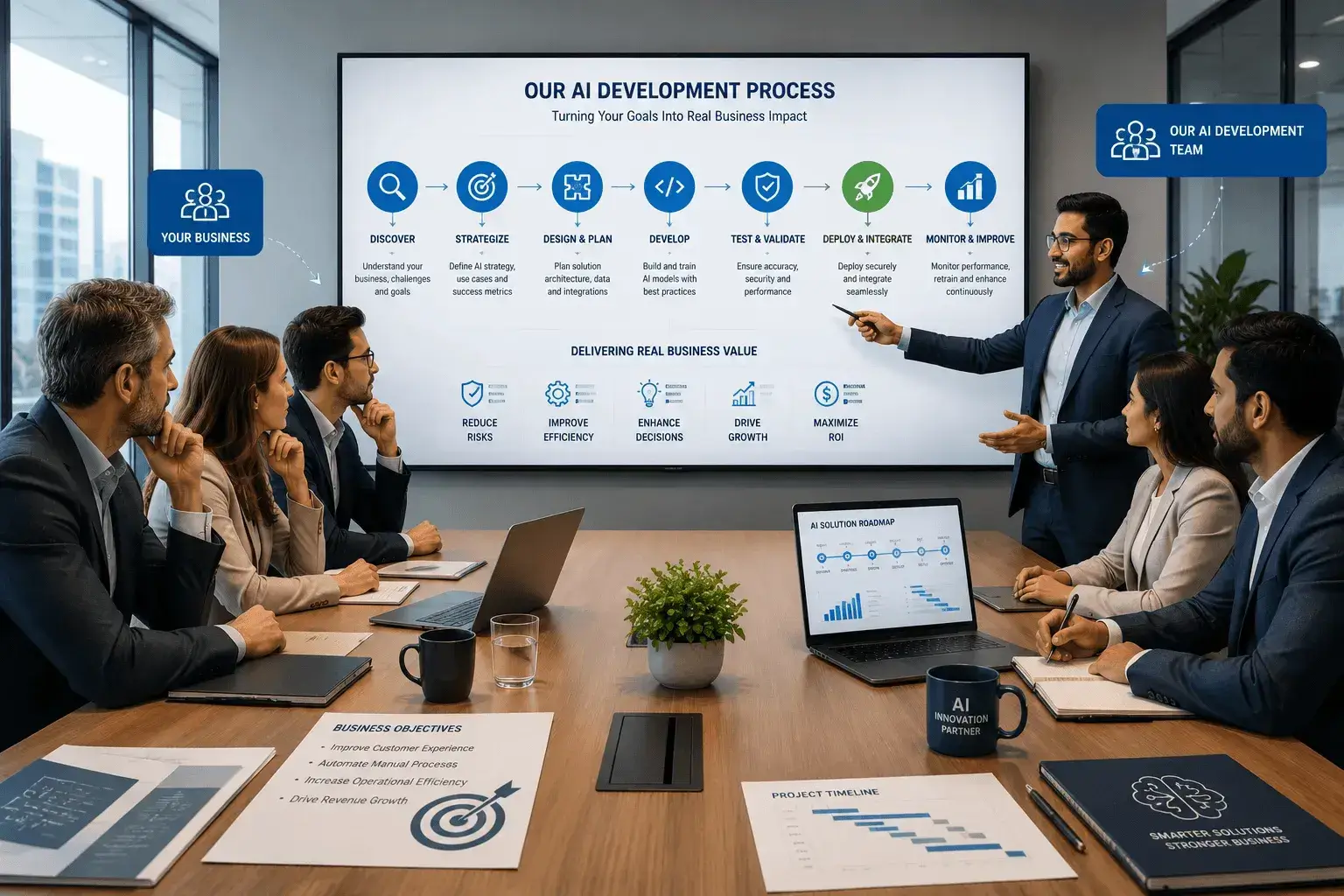
AI projects involve more than software development. They require the right strategy, quality data, secure implementation, and integration with existing business systems. Choosing an experienced AI development company helps reduce technical risks, accelerate deployment, and ensure the solution aligns with your business objectives from the start.
According to McKinsey, more than 70% of organizations now use AI in at least one business function. As AI adoption grows, selecting the right implementation partner has become a key factor in project success.
15 Questions to Ask Before You Hire an AI Development Company
Use these questions during vendor evaluations, discovery calls, or proposal reviews to compare AI development companies consistently.
1. Do They Understand Your Business Problem?

A reliable AI development company should understand your business goals, workflows, and operational challenges before recommending AI solutions.
Avoid companies that immediately recommend AI without first asking detailed business questions.
Look for partners that discuss:
- Business goals
- Current challenges
- Success metrics
- Existing systems
- Expected ROI
Their recommendations should align with measurable outcomes instead of technical buzzwords.
2. What AI Expertise Does the Company Actually Have?
Not every software company specializes in AI.
Many agencies recently added AI to their service list. That does not necessarily mean they have extensive implementation experience.
Rather than asking whether a company "does AI," ask which AI technologies they have implemented in production and how those technologies solved real business problems.
| AI Capability | Why It Matters |
|---|---|
| AI Agent Development | Workflow automation and autonomous task execution |
| Generative AI | Content generation and AI assistants |
| Computer Vision | Image and video analysis |
| Natural Language Processing | Chatbots and document processing |
| Predictive Analytics | Forecasting and business intelligence |
An experienced AI development company should explain where each technology fits your business instead of promoting every AI trend.
In-House AI Team vs. AI Development Company: Key Differences
| In-House Team | AI Development Company |
|---|---|
| Hiring required | Ready-made experts |
| Longer setup | Faster delivery |
| Higher fixed cost | Project-based |
| Internal management | Dedicated PM |
| Slower scaling | Easier scaling |
3. Can They Show Relevant AI Case Studies?
Experience matters.
Request examples that closely match your industry, project size, or business challenge.
Instead of asking only for success stories, ask:
- What challenges occurred?
- How were they resolved?
- What measurable improvements resulted?
- What lessons did the team learn?
Meaningful case studies demonstrate practical experience rather than marketing claims.
4. Do They Offer AI Consulting Before Development?
Many businesses assume they need development immediately. In reality, successful AI projects usually begin with strategy and planning.
Professional AI consulting services help determine:
- Whether AI is the right solution
- Which processes should be automated
- Expected implementation timeline
- Data readiness
- Project feasibility
Skipping the consulting phase often leads to unnecessary development costs.
5. How Do They Handle Custom AI Development?
Every organization has unique processes.
Generic AI tools rarely fit complex business requirements.
Ask how they approach custom AI software development.
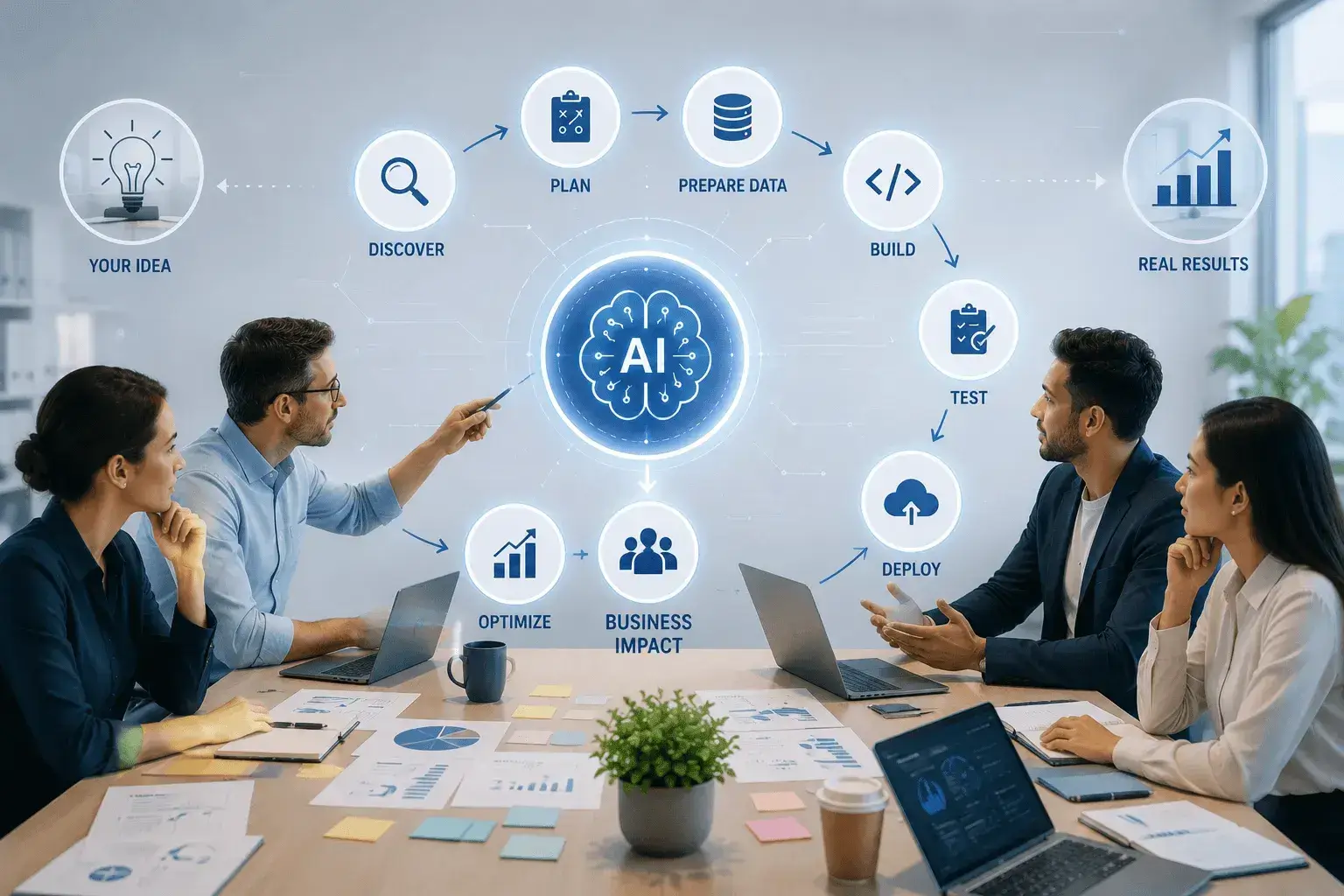
A structured process should include:
| Stage | Deliverable |
|---|---|
| Discovery | Business goals |
| Planning | AI roadmap |
| Data Preparation | Clean datasets |
| Development | AI solution |
| Testing | Validation |
| Deployment | Production |
| Optimization | Continuous improvement |
Customization ensures the AI solution supports your workflows instead of forcing your business to adapt to the software.
6. What Data Will the AI Require?
An AI customer support assistant trained on outdated documentation may provide inaccurate answers, reducing customer trust and increasing support requests.
Ask questions such as:
- What data is required?
- Who owns the data?
- How is sensitive information protected?
- How is data cleaned?
- What happens if data quality is low?
A professional AI development services provider explains these requirements early rather than discovering issues midway through development.
For example, if you're building an AI sales assistant, the model may require CRM records, customer conversations, product documentation, and historical support tickets.
7. How Will They Integrate AI Into Existing Systems?
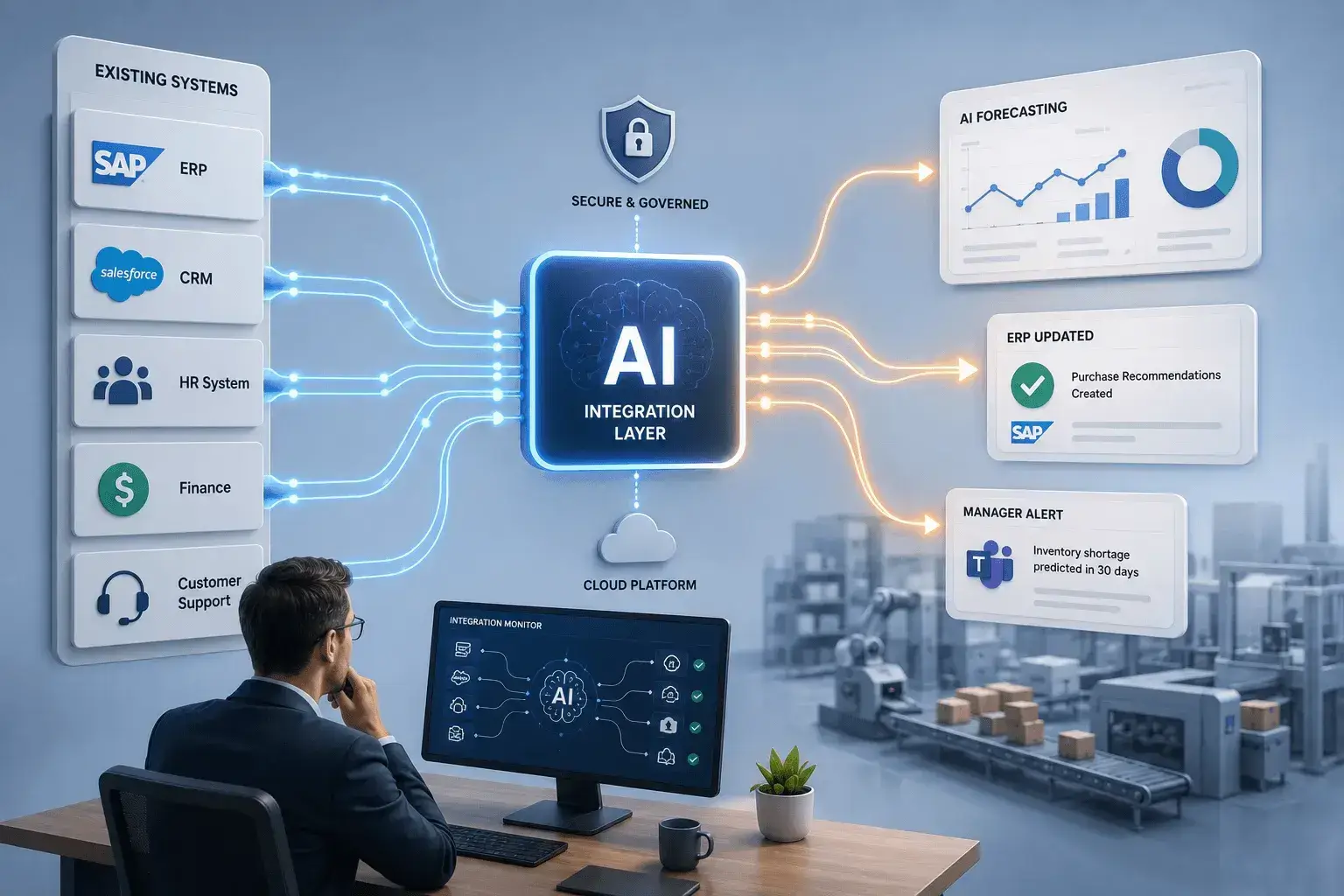
Many organizations already use ERP, CRM, HR, finance, or customer support platforms.
Your AI solution should integrate with these systems without disrupting daily operations.
Discuss:
- API integrations
- Cloud platforms
- Legacy software compatibility
- Security controls
- Deployment strategy
Reliable AI integration services for business reduce operational disruption while maximizing adoption across departments.
For example, a manufacturing company may need an AI forecasting system that retrieves inventory data from SAP, writes purchase recommendations back into the ERP, and alerts managers through Microsoft Teams.
8. How Do They Ensure Security and Compliance?
Business data is valuable.
Your AI partner should explain how they protect it throughout development and deployment.
Ask about:
- Encryption standards
- Access controls
- Secure cloud infrastructure
- Regulatory compliance
- Data governance policies
For industries such as healthcare, finance, and legal services, compliance expertise is just as important as technical capability.
9. Who Will Actually Work on Your Project?
Many companies showcase senior AI experts during sales meetings. However, junior developers often handle the actual project.
Ask who will be involved after the contract is signed.
Clarify the project team, including:
- AI Engineers
- Machine Learning Engineers
- Data Scientists
- Solution Architects
- Project Managers
- QA Engineers
- DevOps Engineers
Also ask whether the team works in-house or relies on freelancers. A dedicated, experienced team generally delivers better consistency and communication.
Ask whether senior AI architects remain involved throughout the project or only participate during the sales process.
Don't evaluate only the company. Evaluate the team assigned to your project. Their experience directly impacts delivery quality and project timelines.
10. How Do They Measure AI Success?
Launching an AI solution is only one milestone.
The real goal is measurable business improvement.
Ask how the company defines project success.
Common KPIs include:
| Business Goal | Example KPI |
|---|---|
| Customer Support | Faster response times |
| Sales | Higher conversion rates |
| Operations | Reduced manual work |
| Marketing | Improved campaign performance |
| Manufacturing | Lower operational costs |
| Analytics | More accurate predictions |
A reliable AI development company should define measurable KPIs before development begins.
11. What Happens After Deployment?
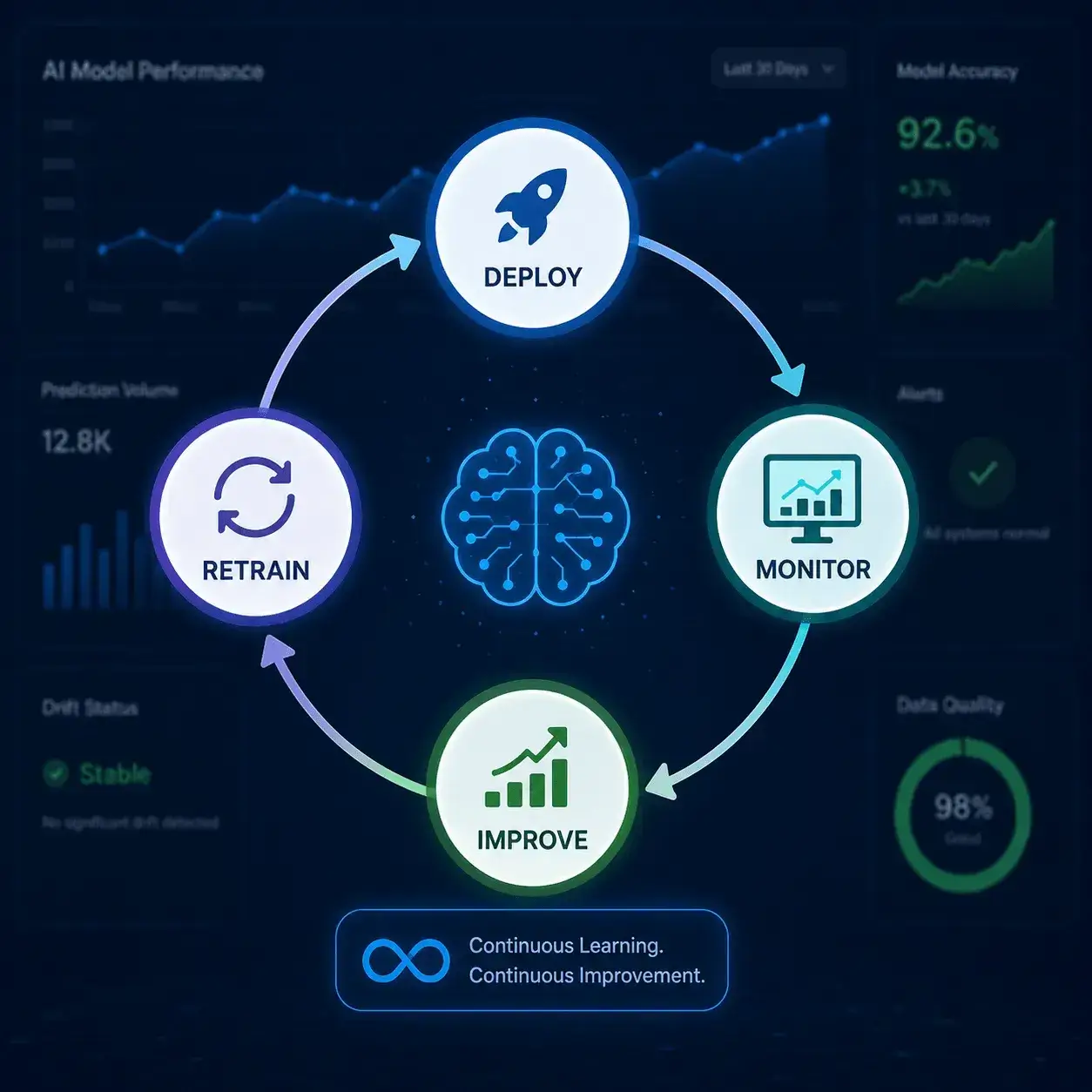
AI solutions require ongoing monitoring and improvement.
Models can lose accuracy as user behavior, market trends, or business data change.
Ask whether they provide:
- Performance monitoring
- Model retraining
- Bug fixes
- Feature enhancements
- Security updates
- Technical support
Post-launch support is a critical part of professional AI implementation services. We've seen organizations launch AI assistants with excellent initial accuracy only to see performance decline six months later because company documentation changed while the model was never updated. Continuous monitoring and retraining prevent this type of degradation.
Without continuous optimization, even well-built AI systems can lose effectiveness over time.
12. Can the Solution Scale as Your Business Grows?
Your AI solution should scale as your business grows.
A retail company may begin with one warehouse but later expand to dozens of locations. Your AI architecture should support additional users, locations, and data volumes without requiring a complete rebuild.
Scalable architecture helps avoid expensive redevelopment later.
13. How Transparent Is Their Development Process?
A transparent development process reduces misunderstandings and keeps projects on schedule.
Ask how they manage projects and communicate progress.
Look for:
- Weekly updates
- Sprint reviews
- Project dashboards
- Dedicated project managers
- Clear documentation
- Defined milestones
14. What Is Included in the Pricing?
The lowest proposal is not always the best value.
Instead, understand exactly what the price covers.
Ask whether the proposal includes:
| Included Service | Why It Matters |
|---|---|
| Discovery Workshop | Defines project scope |
| AI Consulting | Validates business needs |
| Development | Core implementation |
| Testing | Ensures quality |
| Deployment | Production readiness |
| Documentation | Simplifies maintenance |
| Training | Improves user adoption |
| Support | Long-term success |
Transparent pricing prevents unexpected costs later in the project.
Also ask whether pricing includes:
- AI model API costs
- Cloud hosting
- Third-party software licenses
- Future maintenance
15. Why Should You Choose Them Over Other AI Vendors?
This question often reveals how the company differentiates itself.
Instead of asking for marketing statements, request specific differentiators.
Look for answers supported by evidence, such as:
- Proven industry experience
- Successful AI implementations
- Strong client retention
- Dedicated AI specialists
- Long-term support capabilities
- Transparent delivery methodology
If every answer sounds generic, continue evaluating other providers before you hire AI developers.
How to Compare AI Development Companies
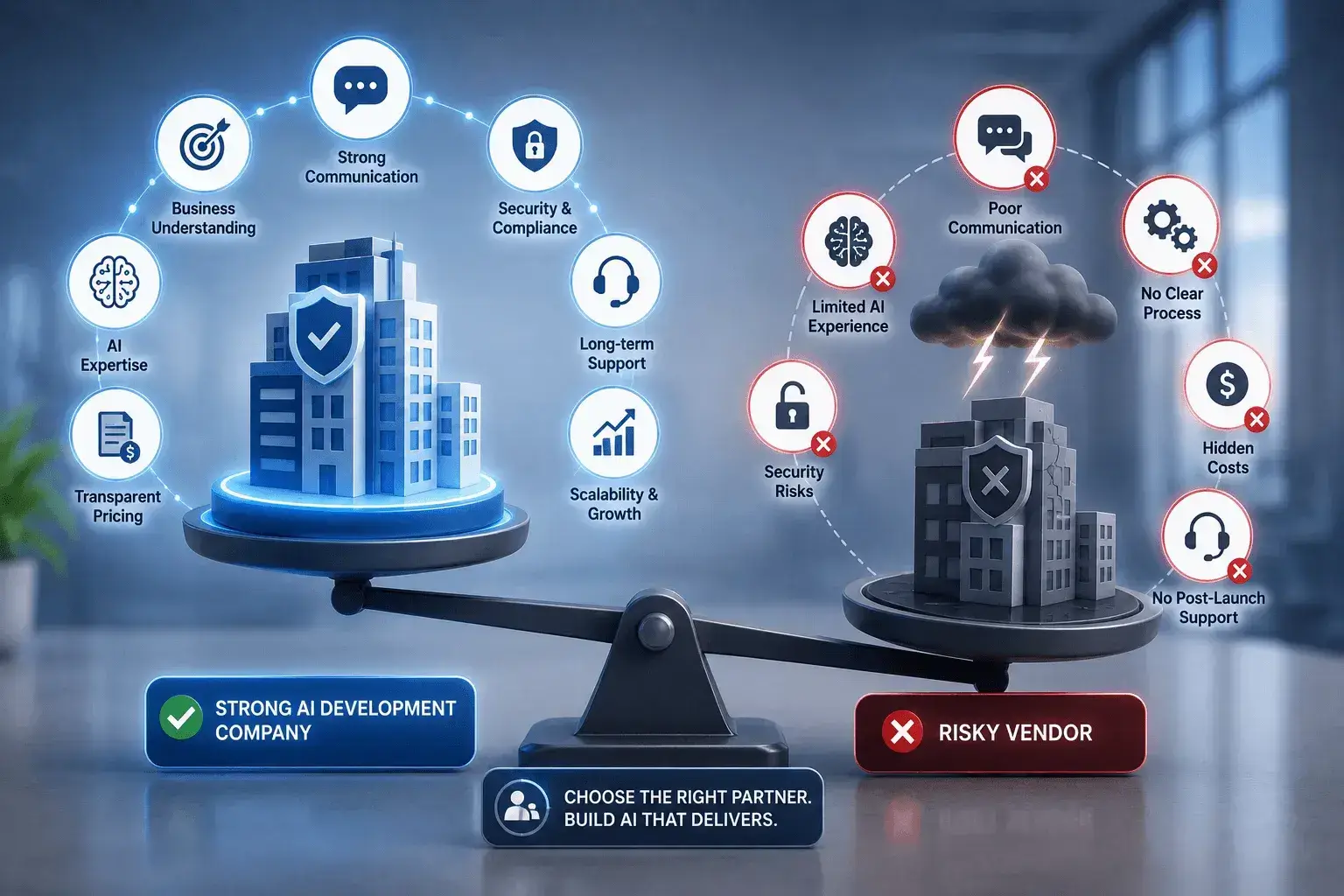
| Evaluation Factor | Strong AI Development Company | Risky Vendor |
|---|---|---|
| Business Discovery | Understands business goals first | Recommends AI immediately |
| AI Expertise | Demonstrates real AI experience | Lacks proven AI implementation experience |
| Communication | Regular updates and documentation | Infrequent updates |
| Pricing | Transparent scope and costs | Hidden charges |
| Security | Strong governance practices | Security practices not clearly defined |
| Support | Offers long-term maintenance | Limited post-launch support |
| Scalability | Plans for future growth | Focuses only on immediate delivery |
Use this comparison as a quick reference when evaluating AI development companies.
Common Red Flags to Watch For
Even a polished proposal can hide potential risks. Be cautious if an AI development company:
- Guarantees unrealistic AI accuracy or results.
- Cannot clearly explain its AI development process.
- Avoids discussing data security or compliance.
- Lacks relevant AI case studies or client references.
- Provides vague timelines or project estimates.
- Cannot identify the team working on your project.
- Relies on technical jargon instead of business outcomes.
- Offers unusually low pricing without defining the scope.
- Does not provide post-launch support or maintenance.
While a single concern may not be a deal-breaker, multiple red flags often indicate a higher risk of project delays, unexpected costs, or poor implementation.
The best AI development companies spend more time understanding your business than selling AI. A partner that asks detailed questions before recommending a solution is more likely to deliver long-term value.
Quick Evaluation Checklist
Before signing a contract, use this checklist to compare AI development companies.
| Evaluation Question | Yes / No |
|---|---|
| Do they understand your business goals? | ☐ |
| Do they have proven AI development experience? | ☐ |
| Can they provide relevant AI case studies? | ☐ |
| Do they offer AI consulting before development? | ☐ |
| Do they build custom AI solutions? | ☐ |
| Can they integrate with your existing systems? | ☐ |
| Do they follow security and compliance best practices? | ☐ |
| Is their pricing transparent? | ☐ |
| Do they provide post-launch support and maintenance? | ☐ |
| Can the solution scale with your business? | ☐ |
If the answer is "Yes" to most of these questions, the company is more likely to be a reliable long-term AI partner than a short-term development vendor.
Conclusion
Choosing the right AI development company is about more than technical expertise. The right partner should understand your business goals, recommend practical AI solutions, and deliver secure, scalable systems that create measurable business value.
Use the 15 questions, comparison table, and evaluation checklist in this guide to compare vendors based on experience, technical capability, security, transparency, and long-term support. A structured evaluation process helps reduce implementation risks and improves the likelihood of a successful AI project.
Ready to Build an AI Solution That Delivers Real Business Value?
At MaxCode IT Solutions, we help startups and enterprises design, develop, integrate, and optimize custom AI solutions that align with their business goals. Whether you're exploring AI for the first time, building a proof of concept, or scaling an enterprise AI initiative, our team works closely with you to identify high-impact use cases, create a practical implementation roadmap, and deliver secure, scalable AI solutions that generate measurable business outcomes. Contact MaxCode IT Solutions today to schedule a free consultation and discuss how AI can support your long-term growth.
Frequently Asked Questions
1. What should I look for in an AI development company?
Look for proven AI expertise, relevant case studies, transparent communication, strong security practices, scalable development processes, and long-term support. The right partner should understand your business goals before recommending an AI solution.
2. How do I know if an AI development company has real experience?
Ask for industry-specific case studies, client references, and examples of completed AI projects. Verify their experience with technologies such as AI agents, generative AI, machine learning, computer vision, or natural language processing that match your project requirements.
3. How much does it cost to hire AI developers?
The cost of hiring AI developers depends on factors such as project complexity, the type of AI solution, data availability, integrations with existing systems, security requirements, and ongoing maintenance. Small proof-of-concept projects may cost a few thousand dollars, while enterprise AI platforms with custom models, advanced integrations, and long-term support require a significantly larger investment. The best approach is to request a detailed proposal that clearly outlines the project scope, deliverables, timeline, and any additional costs, such as AI model APIs, cloud infrastructure, third-party software licenses, and post-launch support.
4. How long does an AI development project usually take?
Simple AI solutions may take a few weeks, while enterprise-level implementations can take several months. The timeline depends on project scope, data readiness, integrations, testing, and deployment requirements.
5. Should I choose custom AI software development instead of an off-the-shelf AI tool?
If your business has unique workflows, integration requirements, or compliance needs, custom AI software development usually provides better flexibility, scalability, and long-term value than generic AI tools.
6. What is the difference between AI consulting services and AI development services?
AI consulting services focus on strategy, feasibility, use-case identification, and implementation planning. AI development services involve designing, building, testing, deploying, and maintaining AI solutions.
7. What does an AI integration service include?
AI integration services connect AI solutions with ERP, CRM, cloud platforms, APIs, databases, and internal applications while ensuring security, scalability, and reliable performance.
8. What industries benefit most from AI implementation services?
AI is widely used across healthcare, finance, retail, manufacturing, logistics, education, real estate, legal services, and customer support. The best use cases are those with repetitive tasks, large datasets, or complex decision-making processes.
9. Why are data analysis and AI services important for business growth?
Data analysis and AI services help businesses identify trends, improve forecasting, automate decisions, optimize operations, and deliver more personalized customer experiences.
10. Is an AI software development company for startups different from one serving enterprises?
Yes. AI software development for startups typically focuses on rapid MVP development and cost-efficient scaling, while enterprise AI projects emphasize large-scale integrations, governance, security, and compliance.
11. Should I hire freelancers or an AI development company?
Freelancers can be suitable for small proof-of-concept projects. For production AI systems, an AI development company provides strategy, development, integration, testing, security, and long-term support through a dedicated team.
Author:

By day, Naina Veerwani wrangles tech trends and leads the charge as CXO at Maxcode IT Solutions Pvt. Ltd with her eight years of industry experience. By night (or whenever inspiration strikes!), she transforms into a content-crafting ninja, crafting insightful blog posts to feed your tech knowledge appetite. When she's not wielding words, you can find her obsessing over the latest tech breakthroughs and social media trends or sometimes over tasty food.