
Your vocation, our passion
We are your one stop creative agency providing
Business IT Services.
Top Notch Digital Marketing Agency that drives revenue
and propel your business to new heights.
We create value for industries like Fin-tech |
Healthcare | Ed-tech | Beauty | Travel | E-commerce
and more.
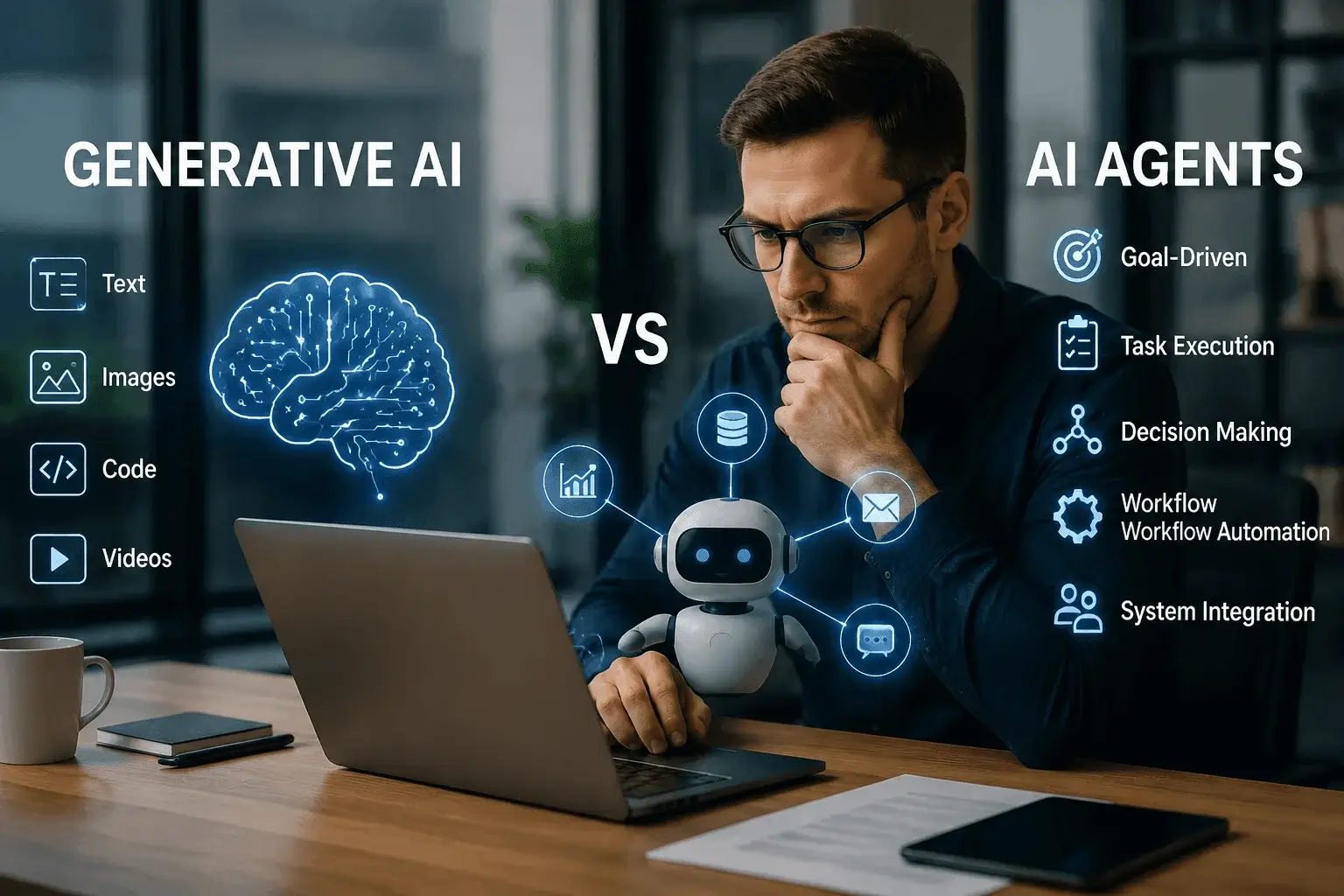
Generative AI vs AI Agents: What's the Difference and Which Does Your Business Need?
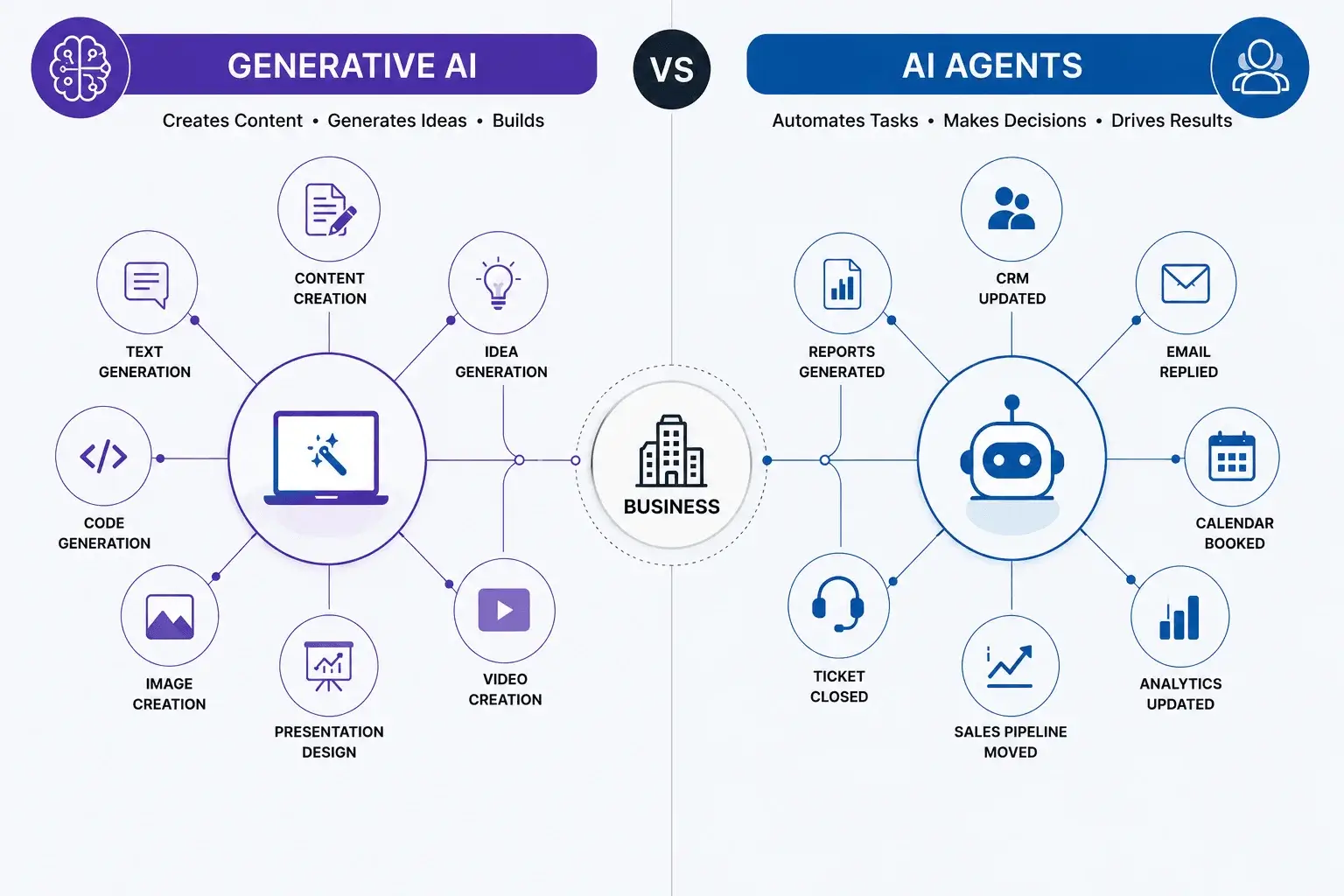
The biggest difference between generative AI vs AI agents is their purpose. Generative AI creates content, such as text, images, code, and videos, based on user prompts. AI agents go beyond content generation. They can make decisions, execute tasks, interact with software, and automate workflows with minimal human intervention. If your goal is creativity and content generation, generative AI is the right choice. If you want intelligent business automation and autonomous task execution, AI agents offer greater long-term value.
| Feature | Generative AI | AI Agents |
|---|---|---|
| Purpose | Create content | Execute tasks |
| Input | User prompts | Goals or objectives |
| Autonomy | Low | High |
| Integrations | Limited | Extensive |
| Best For | Writing, coding, images | Workflow automation |
| Human Role | Direct involvement | Supervision and approvals |
Why Businesses Are Comparing Generative AI and AI Agents
Artificial intelligence is rapidly becoming a business priority. According to McKinsey , 88% of organizations now use AI in at least one business function, yet many leaders still confuse generative AI with AI agents.
Although both technologies rely on AI models, they serve different purposes.
Generative AI focuses on creating content, while AI agents focus on planning, decision-making, and executing tasks.
Understanding this distinction helps organizations invest in the right technology instead of following industry trends.
Whether you are planning generative AI development, building an intelligent application, or exploring enterprise automation, choosing the right solution affects productivity, customer experience, and return on investment.
Many companies ask whether AI agents will replace generative AI. In reality, AI agents often use generative AI to understand requests, generate responses, and make better decisions.
What Is Generative AI?
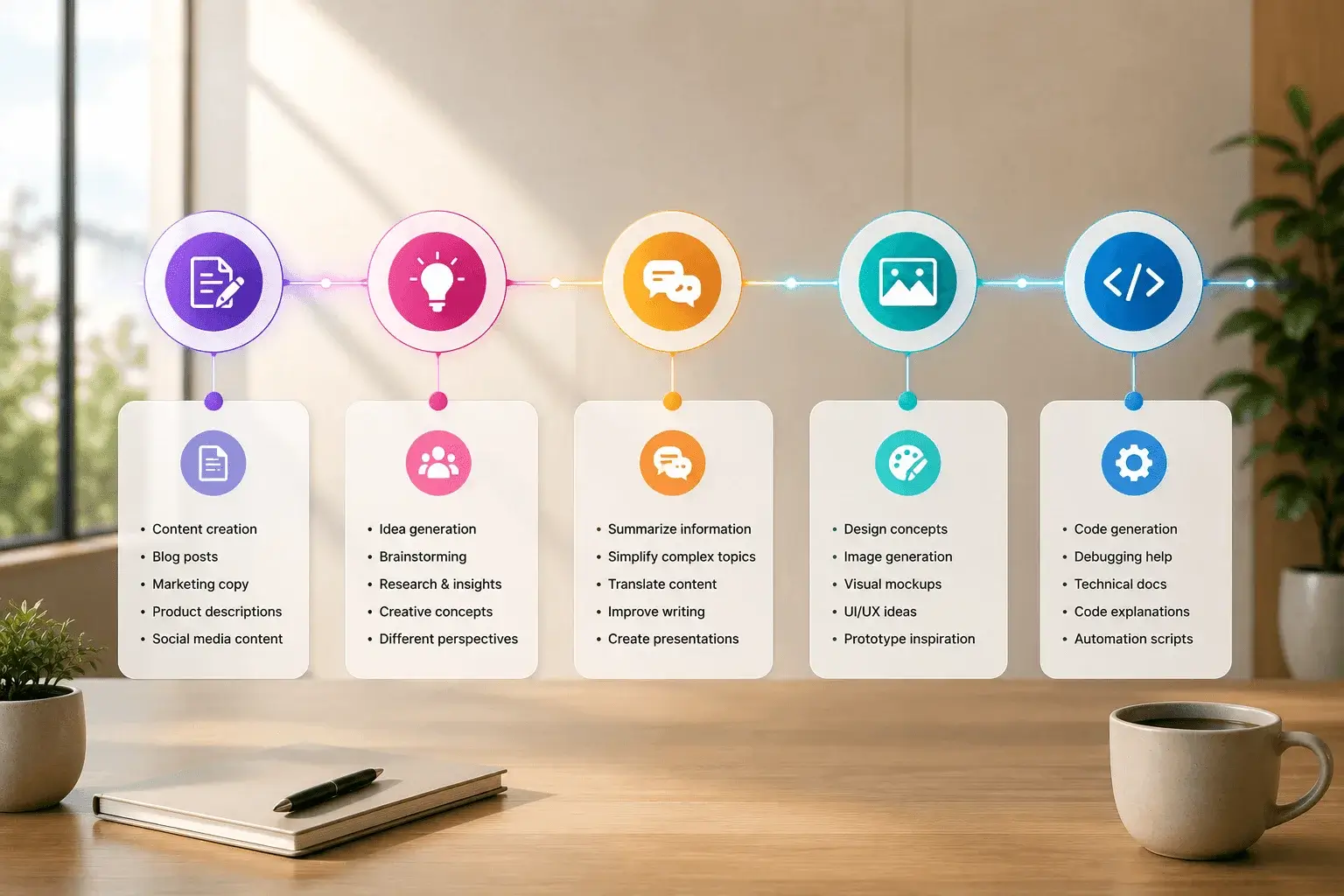
Generative AI refers to artificial intelligence that creates original content from user instructions.
Instead of following fixed rules, these models learn patterns from large datasets and generate new outputs.
Common examples include:
- Writing articles
- Creating marketing copy
- Generating source code
- Producing images
- Creating videos
- Summarizing documents
- Translating languages
Businesses use generative AI development to improve creativity, accelerate content production, and enhance customer interactions.
Common Business Applications
| Use Case | Business Benefit |
|---|---|
| Content Creation | Faster marketing production |
| Customer Support | AI-powered responses |
| Code Generation | Faster software development |
| Knowledge Management | Document summarization |
| Product Descriptions | Improved eCommerce efficiency |
| Sales Content | Faster proposal creation |
Generative AI works best when the primary objective is producing high-quality content quickly.
However, it usually requires users to initiate every interaction.
What Are AI Agents?
AI agents represent the next evolution of business automation.
Unlike generative AI, AI agents do not simply respond to prompts.
They can analyze information, make decisions, perform tasks, interact with applications, and achieve predefined objectives with limited human involvement.
An AI agent typically combines several technologies, including:
- Large Language Models
- Planning systems
- Memory
- APIs
- Business rules
- External software integrations
This allows the agent to complete complex workflows instead of producing a single response. Microsoft reports that employees spend a significant portion of their workweek on repetitive administrative tasks, making AI agents valuable for automating routine work. For example, a sales AI agent can qualify website leads, update HubSpot, schedule meetings in Google Calendar, and notify a sales representative in Slack without manual intervention.
Businesses increasingly partner with an experienced AI agent development company to automate repetitive operations and improve efficiency across departments.
Generative AI vs AI Agents: Key Differences
Although these technologies share similar foundations, their capabilities differ significantly.
| Feature | Generative AI | AI Agents |
|---|---|---|
| Primary Purpose | Generate content | Execute tasks |
| User Interaction | Prompt-based | Goal-based |
| Decision Making | Limited | Autonomous |
| Workflow Execution | No | Yes |
| Software Integration | Basic | Extensive |
| Memory | Usually session-based | Long-term context |
| Business Automation | Limited | Advanced |
The most important difference is autonomy.
Generative AI waits for instructions.
AI agents actively work toward completing objectives.
Common Misconceptions About Generative AI and AI Agents
Many people assume AI agents and generative AI are the same technology, but they serve different purposes.
Here are a few common misconceptions:
Myth: AI agents replace generative AI.
Reality: Most AI agents actually use generative AI to understand language and communicate with users.
Myth: Generative AI can automate entire business workflows.
Reality: Generative AI generates content, while AI agents coordinate actions across systems.
Myth: AI agents always operate without humans.
Reality: Many enterprise AI agents include approval steps for security and compliance.
How Each Technology Thinks About a Task
Imagine a sales representative asks:
"Help me prepare for tomorrow's client meeting."
Generative AI Response
Generative AI may:
- Summarize the client
- Draft an agenda
- Suggest discussion points
- Create presentation notes
The work stops there.
The employee completes the remaining tasks.
AI Agent Response
Review the client's HubSpot history, analyze previous meeting notes, research recent company news, generate a presentation, schedule the meeting in Google Calendar, send invitations, draft follow-up emails, and prepare CRM updates for manager approval where required.
This difference explains why businesses increasingly invest in AI automation services rather than standalone AI tools.
Think of generative AI as an expert assistant that creates information. Think of an AI agent as a skilled employee who can complete an entire assignment.
When Should Your Business Use Generative AI?
Generative AI is an excellent choice when your organization needs to create content faster without sacrificing quality.
It is especially valuable for teams that produce large amounts of written, visual, or technical content every day.
Consider generative AI development if your business wants to:
- Create marketing content at scale
- Generate software code faster
- Improve customer support responses
- Build AI-powered writing assistants
- Summarize large documents
- Translate multilingual content
- Generate product descriptions
- Assist employees with knowledge discovery
Many organizations also work with an experienced AI chatbot development company to develop conversational assistants powered by generative AI. These chatbots improve customer engagement while reducing support workloads.
When Should Your Business Choose AI Agents?
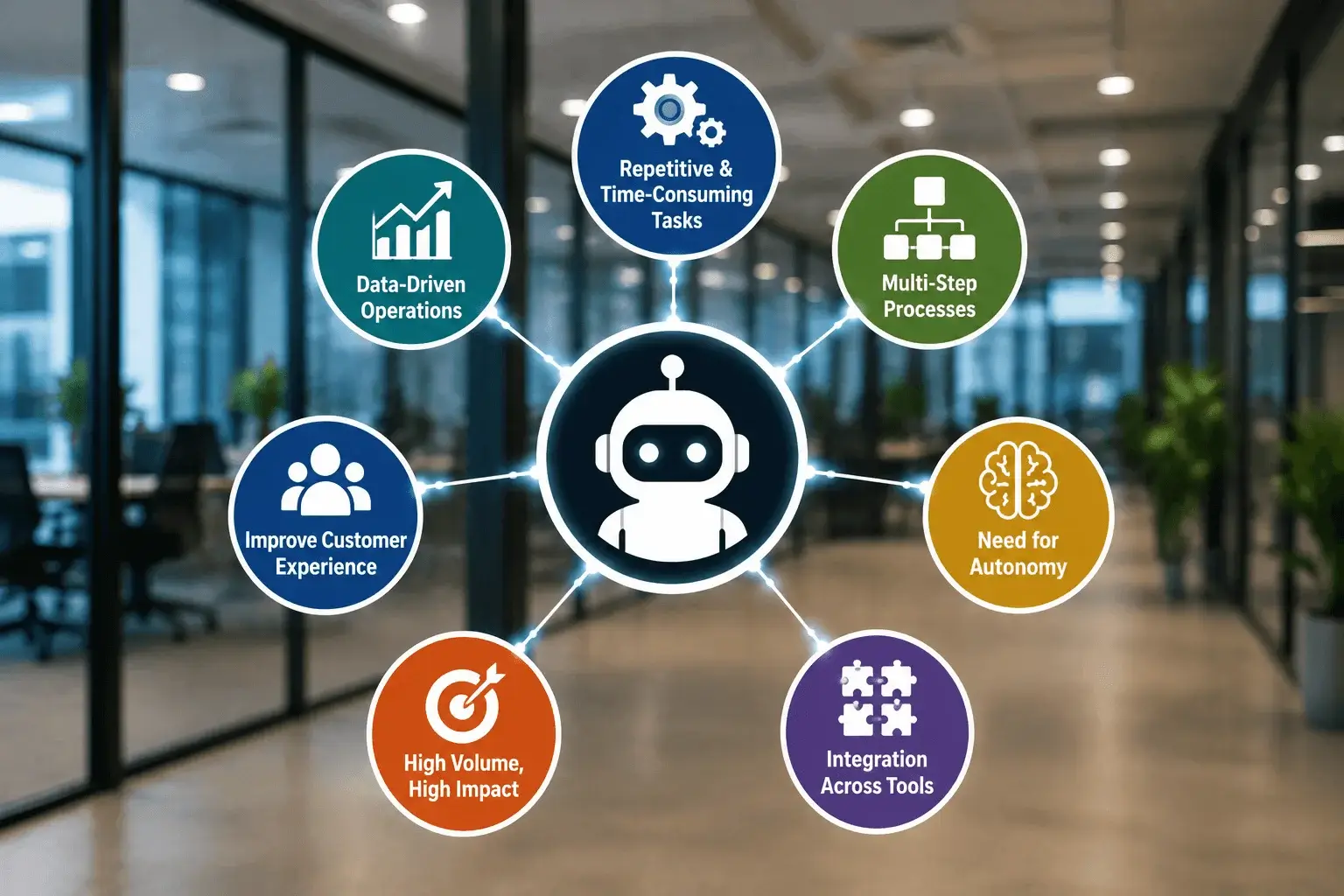
AI agents are ideal when your business needs more than content generation.
They excel at executing multi-step processes, making decisions, and coordinating actions across different systems.
Unlike generative AI, AI agents continue working after receiving an objective while operating within predefined business rules, permissions, and approval workflows.
They gather information, evaluate context, interact with business systems, and complete tasks with minimal supervision.
If your organization wants to reduce manual work while improving operational efficiency, AI agents are often the better investment.
Common AI Agent Business Applications
| Business Function | How AI Agents Add Value |
|---|---|
| Customer Support | Categorize support requests, draft responses, update Zendesk, escalate urgent issues, and sync customer records with Salesforce. |
| Sales | Score inbound leads, update HubSpot, schedule demos, and send personalized follow-up emails automatically. |
| HR | Screen resumes, arrange interviews, and answer employee questions |
| Finance | Match invoices with purchase orders, flag unusual transactions, and generate month-end reports. |
| Operations | Trigger inventory updates, notify warehouse teams, and synchronize ERP and CRM systems. |
| IT Support | Reset passwords, route tickets, provision user accounts, and escalate complex incidents automatically. |
Many organizations partner with an experienced AI agent development company to replace repetitive administrative work with intelligent automation.
Generative AI vs AI Agents: Real Business Comparison
Understanding where each technology performs best makes investment decisions easier.
| Business Need | Generative AI | AI Agents |
|---|---|---|
| Content Creation | ⭐⭐⭐⭐⭐ | ⭐⭐ |
| Business Automation | ⭐⭐ | ⭐⭐⭐⭐⭐ |
| Decision Support | ⭐⭐⭐ | ⭐⭐⭐⭐⭐ |
| Multi-Step Tasks | ⭐ | ⭐⭐⭐⭐⭐ |
| Customer Engagement | ⭐⭐⭐⭐ | ⭐⭐⭐⭐ |
| Workflow Management | ⭐ | ⭐⭐⭐⭐⭐ |
| Process Optimization | ⭐⭐ | ⭐⭐⭐⭐⭐ |
| Human Assistance | ⭐⭐⭐⭐⭐ | ⭐⭐⭐⭐ |
Neither solution is universally better.
The right choice depends on the business problem you want to solve.
Businesses rarely choose between generative AI and AI agents. Increasingly, they adopt orchestrated AI agents powered by generative AI to automate complex workflows while keeping humans involved in critical decisions.
Can Generative AI and AI Agents Work Together?
Absolutely.
In fact, many modern AI solutions combine both technologies.
Generative AI provides intelligence for understanding language, creating content, and communicating naturally.
AI agents use that intelligence to make decisions and complete tasks.
Think of generative AI as the brain for communication.
Think of AI agents as the operational system that gets work done.
Example Workflow
A customer submits a support request.
The AI agent:
- Reads the request.
- Uses generative AI to understand the customer's intent.
- Searches internal knowledge bases.
- Generates an accurate response.
- Updates the CRM.
- Creates a support ticket if needed.
- Sends confirmation to the customer.
- Notifies the support team when human intervention is required.
The customer experiences a seamless interaction without realizing multiple AI technologies worked together. This combined approach is evolving into agentic AI, where multiple specialized AI agents collaborate under human oversight to complete increasingly complex business processes.
How AI Workflow Automation Changes Business Operations
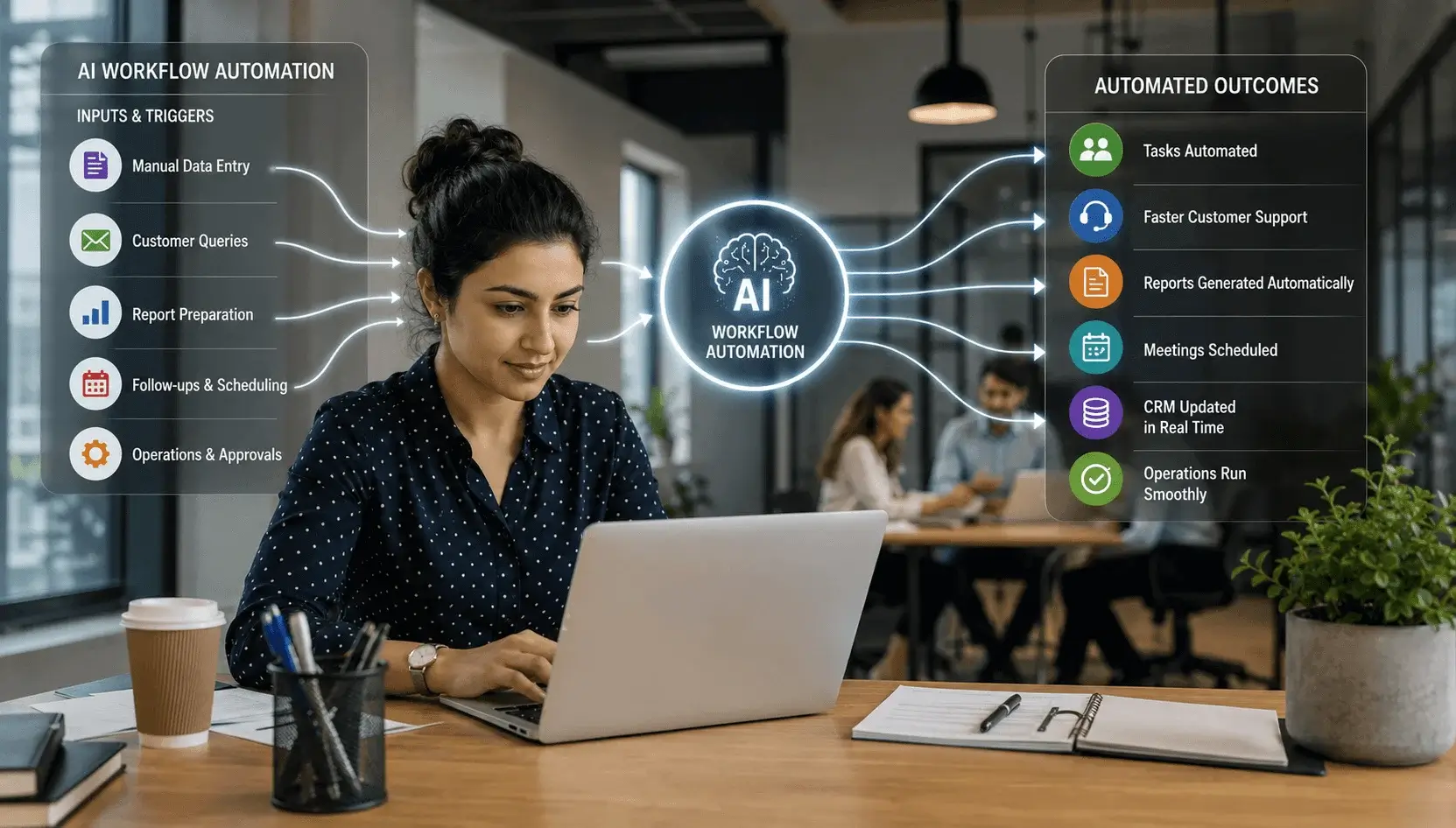
Many organizations struggle with repetitive processes that consume valuable employee time. Deloitte reports that intelligent automation helps organizations improve efficiency while reducing manual effort across business operations.
Examples include:
- Entering invoice data into ERP systems
- Prioritizing customer emails
- Routing purchase approvals
- Qualifying inbound sales leads
This is where AI workflow automation creates measurable business value.
Instead of automating one isolated task, AI agents automate entire business processes.
For example, a new sales inquiry can trigger an automated workflow that:
- Captures lead information.
- Enriches company data.
- Scores the opportunity.
- Assigns the lead to a salesperson.
- Schedules a meeting.
- Sends a personalized email.
- Updates the CRM.
No manual intervention is required unless an exception occurs.
AI-Powered Web Applications Are Becoming the New Standard
Businesses no longer want software that simply stores information.
They want software that actively assists users.
This demand is accelerating adoption of AI-powered web applications.
Examples include:
| Application | AI Capability |
|---|---|
| Customer Portal | Intelligent virtual assistant |
| Healthcare Platform | Summarize patient records and draft clinical notes |
| Legal Software | Contract analysis |
| Finance Dashboard | Forecast cash flow and identify unusual spending patterns |
| HR Platform | Candidate screening |
| eCommerce Store | Personalized recommendations |
These intelligent applications improve user experience while reducing operational costs.
How AI SaaS Products Benefit from AI Agents
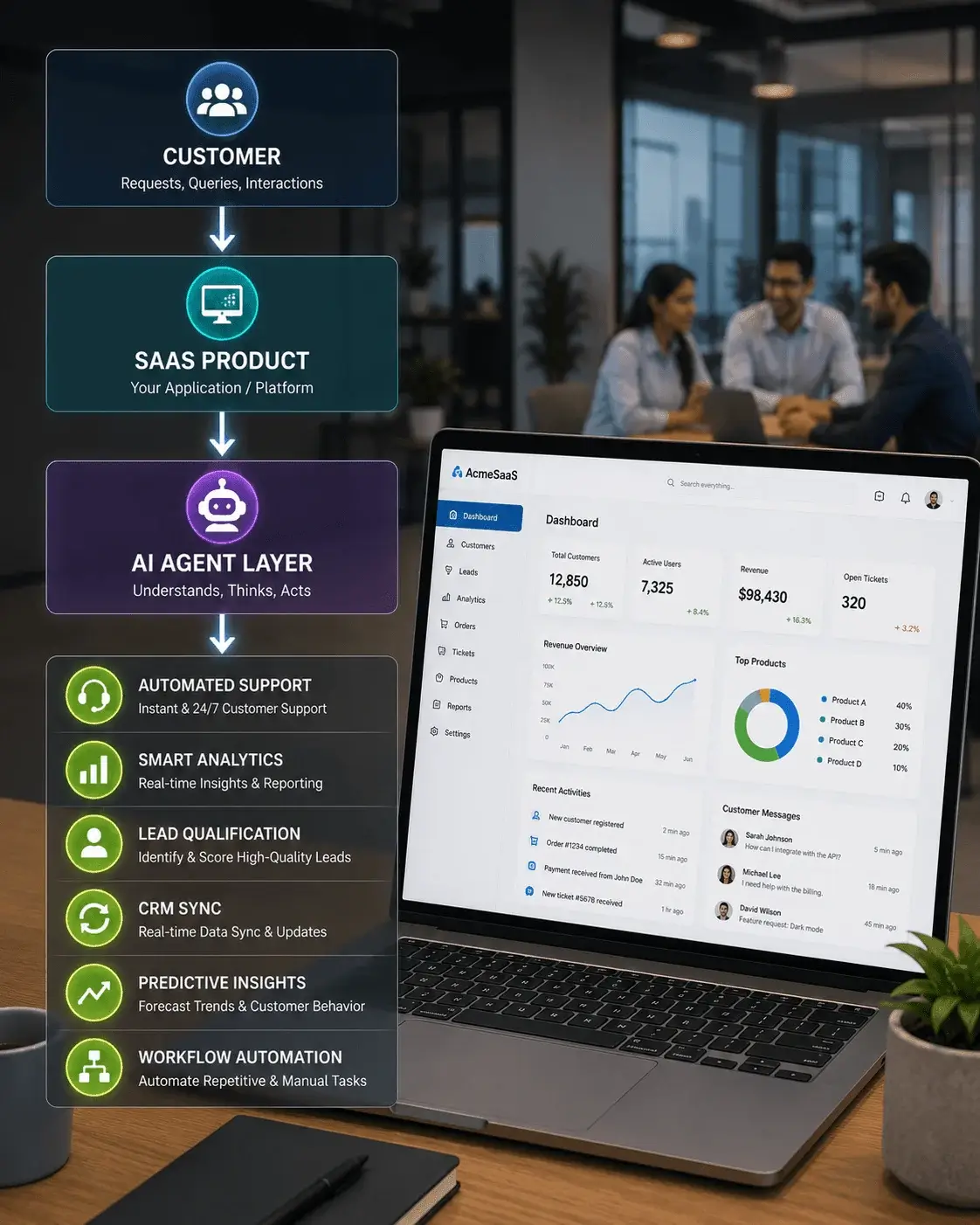
Software companies are rapidly embedding AI into their SaaS platforms. Microsoft's Work Trend Index found that 79% of business leaders believe AI adoption is essential to staying competitive.
Instead of adding a chatbot as an extra feature, they build intelligent assistants directly into the product.
Examples include:
- Automated onboarding
- Smart reporting
- Predictive recommendations
- Workflow automation
- Intelligent search across emails, documents, and CRM records
- Personalized dashboards
Businesses investing in AI SaaS development gain a competitive advantage by delivering more intelligent user experiences.
Customers increasingly expect software to help them complete work, not simply provide tools. This shift is driving the adoption of AI coworkers that assist users and autonomous enterprise software capable of handling routine business tasks.
How to Decide Which AI Solution Your Business Needs
Before investing in AI, answer one simple question:
What problem are you trying to solve?
If your primary challenge is creating information, generative AI is likely sufficient.
If your goal is reducing manual work and improving efficiency, AI agents provide greater long-term value.
Use this decision framework.
| Your Goal | Recommended Solution |
|---|---|
| Create blogs, emails, or marketing content | Generative AI |
| Build an intelligent chatbot | Generative AI + AI Agent |
| Automate customer service | AI Agent |
| Automate internal operations | AI Agent |
| Improve employee productivity | Generative AI |
| Automate sales workflows | AI Agent |
| Build intelligent enterprise software | Combined Solution |
Notice that several business scenarios benefit from combining both technologies.
As AI continues to evolve, many organizations are adopting hybrid solutions that combine generative AI with orchestrated AI agents to deliver greater automation and flexibility.
Why AI Consulting Should Come Before Development
Many organizations begin with technology instead of strategy.
That often leads to unnecessary costs and disappointing results.
Professional AI consulting services help businesses:
- Identify the right AI opportunities.
- Assess data readiness.
- Define measurable success metrics.
- Prioritize high-impact use cases.
- Select the appropriate AI architecture.
- Estimate implementation timelines.
A strategic roadmap ensures that AI investments align with business objectives instead of chasing the latest trend.
The most successful AI projects start with business strategy, not technology. Companies that define clear objectives before development are far more likely to achieve measurable ROI.
Conclusion
The debate around generative AI vs AI agents is not about choosing the more advanced technology. It is about selecting the right solution for your business objectives.
If your priority is generating content, accelerating software development, or improving customer communication, generative AI can deliver immediate value.
If your goal is automating complex business processes, reducing manual work, and enabling intelligent decision-making, AI agents provide greater long-term impact.
Many organizations achieve the best results by combining both technologies, particularly as enterprise AI adoption continues to accelerate across industries. Generative AI enhances communication and content creation, while AI agents execute tasks, interact with business systems, and automate end-to-end workflows.
Before investing in AI, define your business goals, evaluate your existing processes, and identify where automation will create measurable value. A strategic approach will always outperform adopting AI simply because it is trending.
Ready to Build the Right AI Solution?
At MaxCode IT Solutions, we help businesses move beyond AI experimentation to real business outcomes. Our team designs, develops, and integrates AI solutions tailored to your goals, industry, and existing technology stack.
Whether you need generative AI development, an experienced AI agent development company, AI automation services, or end-to-end AI-powered web application development, we deliver scalable solutions that improve productivity and support long-term growth.
From strategy and architecture to deployment and ongoing optimization, we partner with businesses to build AI systems that solve real operational challenges.
Talk to our AI experts today and discover which AI solution is right for your business.
Frequently Asked Questions
1. What is the main difference between generative AI and AI agents?
The main difference is their purpose. Generative AI creates new content such as text, images, code, or videos. AI agents use AI to make decisions, interact with systems, and complete tasks with minimal human involvement.
2. Is generative AI better than AI agents?
Neither is universally better. Generative AI is ideal for content creation and knowledge assistance. AI agents are better for business automation, workflow execution, and decision-making. The best choice depends on your business goals.
3. Can AI agents use generative AI?
Yes. Many AI agents rely on generative AI models to understand user requests, generate responses, summarize information, and communicate naturally while completing complex workflows.
4. Can ChatGPT be considered an AI agent?
No. ChatGPT is primarily a generative AI application designed to understand prompts and generate content. While it can perform simple tasks, it does not autonomously plan, execute multi-step workflows, or interact with business systems like a true AI agent unless those capabilities are added through external tools and integrations.
5. When should a business invest in generative AI development?
Businesses should consider generative AI development when they want to improve content creation, customer engagement, software development, document processing, or employee productivity through AI-powered assistance.
6. Why should I work with an AI agent development company?
An experienced AI agent development company can design intelligent systems that integrate with your existing applications, automate workflows, and scale as your business grows. This reduces implementation risks and improves long-term ROI.
7. What is the difference between AI copilots and AI agents?
AI copilots assist users by providing recommendations, generating content, or answering questions, while AI agents can independently plan and execute multi-step tasks. Copilots support human decision-making, whereas AI agents focus on executing business tasks with minimal supervision.
8. How does AI workflow automation differ from traditional automation?
Traditional automation follows predefined rules and workflows. AI workflow automation adapts to changing conditions, analyzes information, makes contextual decisions, and handles more complex business scenarios.
9. Are AI agents built using large language models (LLMs)?
Often, yes. Many AI agents use large language models to understand instructions, reason through tasks, and communicate naturally. However, they also combine planning, memory, APIs, business rules, and software integrations to complete goals autonomously.
10. Should I start with AI consulting before development?
Yes. Professional AI consulting services help identify the right use cases, assess data readiness, define success metrics, and recommend the most effective AI strategy before development begins. This reduces risk and ensures your investment aligns with business objectives.
Author:

By day, Naina Veerwani wrangles tech trends and leads the charge as CXO at Maxcode IT Solutions Pvt. Ltd with her eight years of industry experience. By night (or whenever inspiration strikes!), she transforms into a content-crafting ninja, crafting insightful blog posts to feed your tech knowledge appetite. When she's not wielding words, you can find her obsessing over the latest tech breakthroughs and social media trends or sometimes over tasty food.