
Your vocation, our passion
We are your one stop creative agency providing
Business IT Services.
Top Notch Digital Marketing Agency that drives revenue
and propel your business to new heights.
We create value for industries like Fin-tech |
Healthcare | Ed-tech | Beauty | Travel | E-commerce
and more.
AI App Development Cost in 2026: How Much Does It Cost to Build an AI Application?

The cost to build an AI-powered application in 2026 typically ranges from $30,000 to $500,000+, depending on the application's complexity, AI capabilities, integrations, security requirements, and deployment scale. A simple AI MVP may cost between $30,000–$70,000, while enterprise-grade AI platforms with custom models, complex integrations, automation, and compliance requirements can exceed $300,000.
The biggest cost drivers are AI model selection, custom development, data preparation, integrations, infrastructure, and long-term maintenance—not simply the number of screens or features. For most businesses, using existing AI models instead of building custom AI significantly reduces both development time and upfront costs. Businesses that clearly define requirements during discovery typically reduce costly revisions later in development.
The table below provides a quick overview of typical AI application development costs based on project scope and complexity.
| AI Application | Estimated Cost |
|---|---|
| AI MVP | $30k–70k |
| AI Web App | $60k–150k |
| AI SaaS | $120k–300k |
| Enterprise AI | $250k–500k+ |
How Much Does an AI-Powered Application Cost?
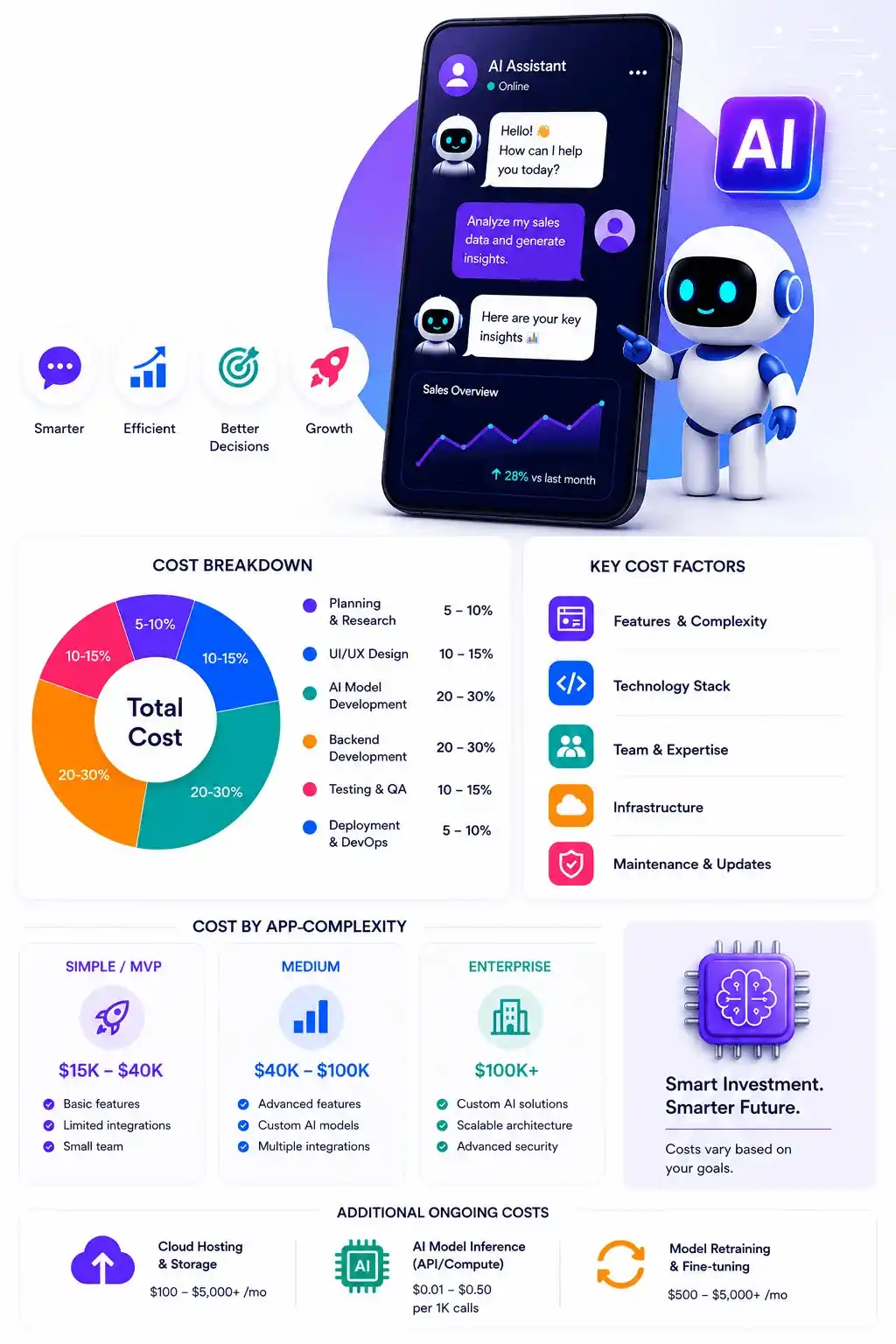
There is no fixed price for AI software because every project has different requirements.
Why two AI apps can have completely different prices
A customer support chatbot using an existing AI model may cost less than $70,000, while a healthcare platform requiring custom AI models, regulatory compliance, and enterprise-grade security can exceed $300,000. The difference comes from the complexity of the AI, the quality of data, required integrations, security requirements, and long-term scalability.
Instead of asking, "How much does AI cost?" businesses should ask:
- What business problem are we solving?
- What AI capabilities are required?
- Will we use existing AI models or train our own?
- How many business systems require integration?
Answering these questions creates a far more accurate budget.
Estimated AI Development Costs in 2026
| Application Type | Cost | Timeline | Best For |
|---|---|---|---|
| AI MVP | $30k–70k | 2–3 months | Startups |
| AI Web App | $60k–150k | 3–5 months | SMEs |
| AI SaaS | $120k–300k | 5–8 months | Growing companies |
| Enterprise AI | $250k–500k+ | 8–12 months | Large enterprises |
These estimates include design, development, testing, deployment, and initial implementation.
Businesses rarely overspend because AI technology is inherently expensive. Most budget overruns happen because project scope changes after development begins. Investing time in discovery and architecture usually saves money during implementation.
What Affects AI App Development Cost?
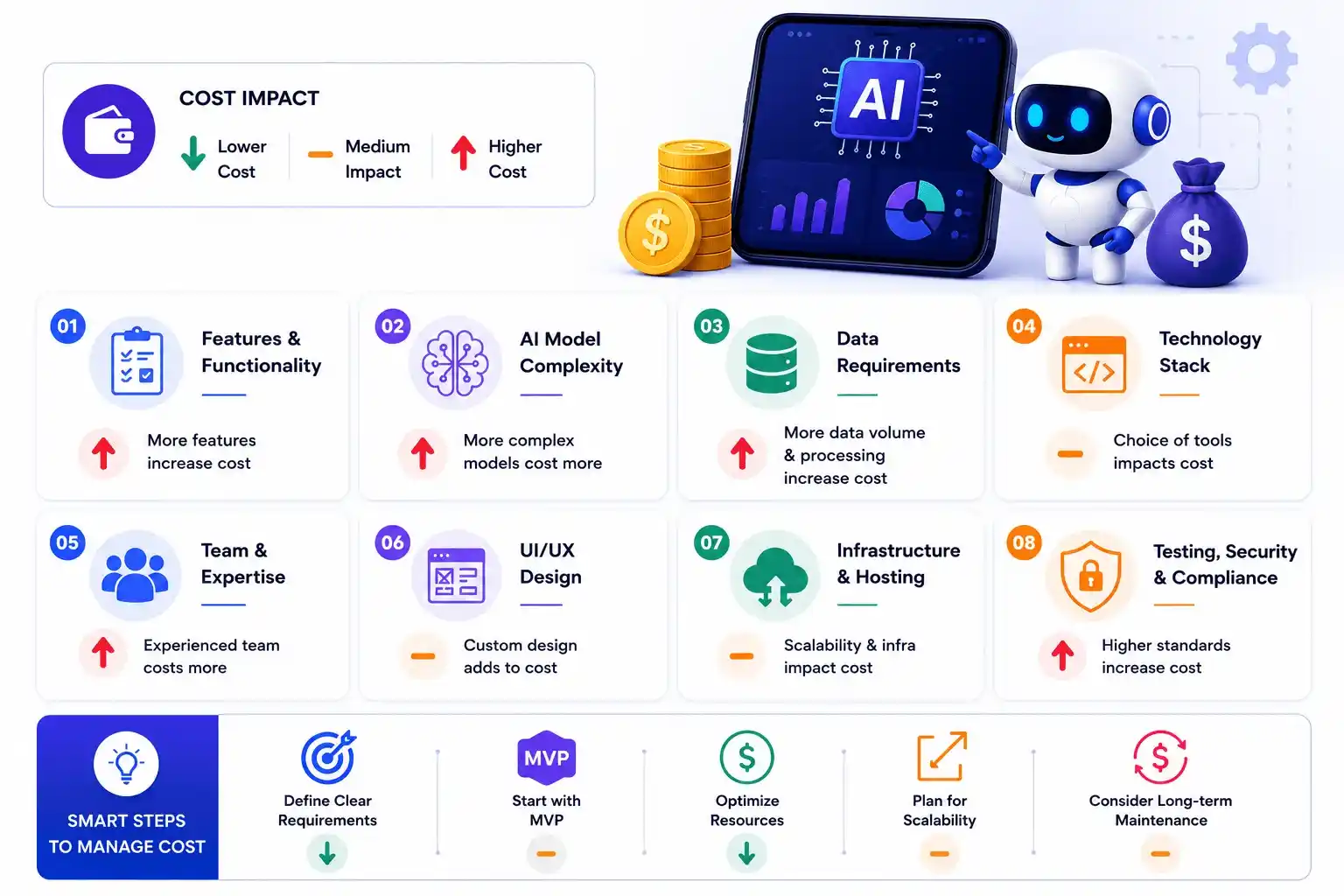
Several technical decisions influence the final investment.
1. AI Features
Basic automation costs significantly less than intelligent decision-making systems. Features such as AI chatbots or document summarization require less development effort than advanced capabilities like computer vision, predictive analytics, or multi-agent workflows. As AI functionality becomes more sophisticated, development, testing, infrastructure, and optimization requirements also increase.
Examples include:
- AI chat assistants
- Document processing
- Recommendation engines
- Predictive analytics
- Computer vision
- Voice recognition
- Multi-agent workflows
Each additional AI capability increases development effort.
2. Custom AI vs Existing Models
Many businesses no longer need to build AI models from scratch.
Modern applications often use advanced APIs while adding custom workflows and business logic.
| Approach | Cost | Best For |
|---|---|---|
| Existing AI APIs | Lower | Most businesses |
| Fine-Tuned Models | Medium | Industry-specific use cases |
| Custom AI Models | Highest | Unique enterprise requirements |
Existing AI APIs are ideal for applications such as customer support chatbots, content generation, and workflow automation. Fine-tuned models work well for industry-specific use cases, while fully custom AI models are best suited for organizations that require proprietary intelligence, strict compliance, or unique competitive advantages.
For most organizations, leveraging existing models offers the fastest return on investment.
3. User Experience
AI applications still require exceptional software design. Even the most advanced AI model delivers little value if users find the application difficult to use. Designing intuitive dashboards, responsive interfaces, and efficient workflows improves adoption but also adds to development time and overall project costs.
Development costs increase when applications include:
- Customer portals
- Admin dashboards
- Mobile support
- Advanced analytics
- Real-time collaboration
Professional UI/UX remains a major investment.
4. Integrations
Most AI applications connect with existing business software. Every integration requires API development, authentication, data mapping, testing, and ongoing maintenance. As the number of connected systems increases, implementation becomes more complex and development costs rise.
Common integrations include:
- CRM systems
- ERP platforms
- Payment gateways
- Document storage
- Email platforms
- Calendar systems
- Business intelligence tools
More integrations generally mean higher implementation costs.
5. Data Preparation
AI depends on quality data. Preparing data is often one of the most time-consuming stages of AI development because information may be incomplete, duplicated, or stored across multiple systems. High-quality data improves AI accuracy but requires additional effort before development begins.
Development often includes:
- Data cleaning
- Data labeling
- Database migration
- Data validation
- Workflow mapping
Poor data quality increases both timelines and budgets.
How Different Cost Factors Impact Your Budget

| Cost Factor | Impact on Development Cost |
|---|---|
| AI Features | High |
| Custom AI Models | Very High |
| UI/UX Design | Medium |
| Third-Party Integrations | High |
| Data Preparation | High |
| Security & Compliance | High |
Understanding these cost drivers helps businesses prioritize features, plan realistic budgets, and avoid unexpected development expenses.
AI Development Timeline
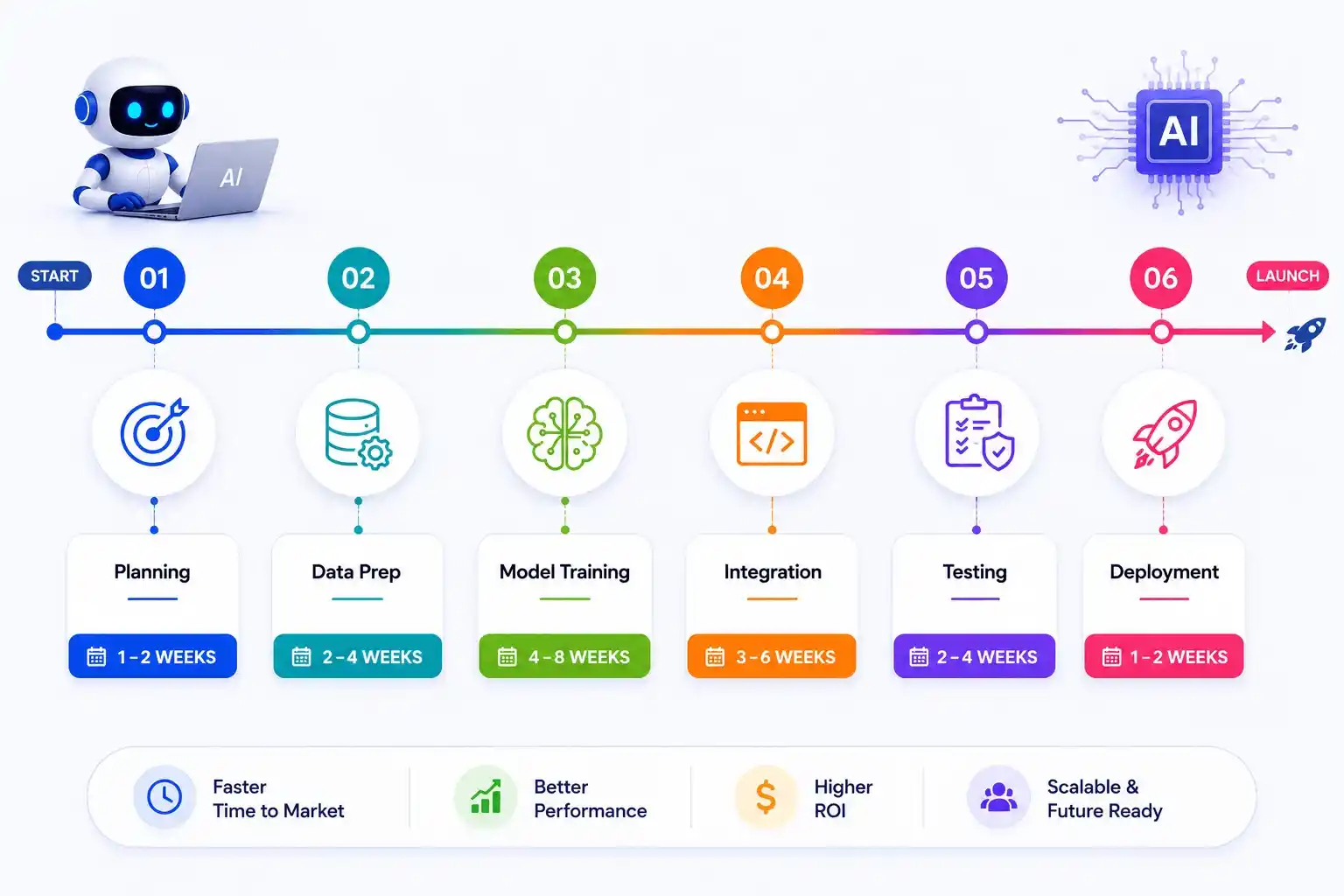
Project duration often correlates with complexity.
| Project | Timeline |
|---|---|
| AI MVP | 2–3 months |
| AI Business Application | 3–5 months |
| AI SaaS Platform | 5–8 months |
| Enterprise AI Solution | 8–12+ months |
Planning and discovery typically reduce delays during development. Delays are most commonly caused by changing project requirements, complex third-party integrations, and poor data quality rather than software development itself.
Rushing AI projects often increases costs. Investing more time in discovery usually reduces expensive revisions later.
AI Model Costs: API vs Custom Development
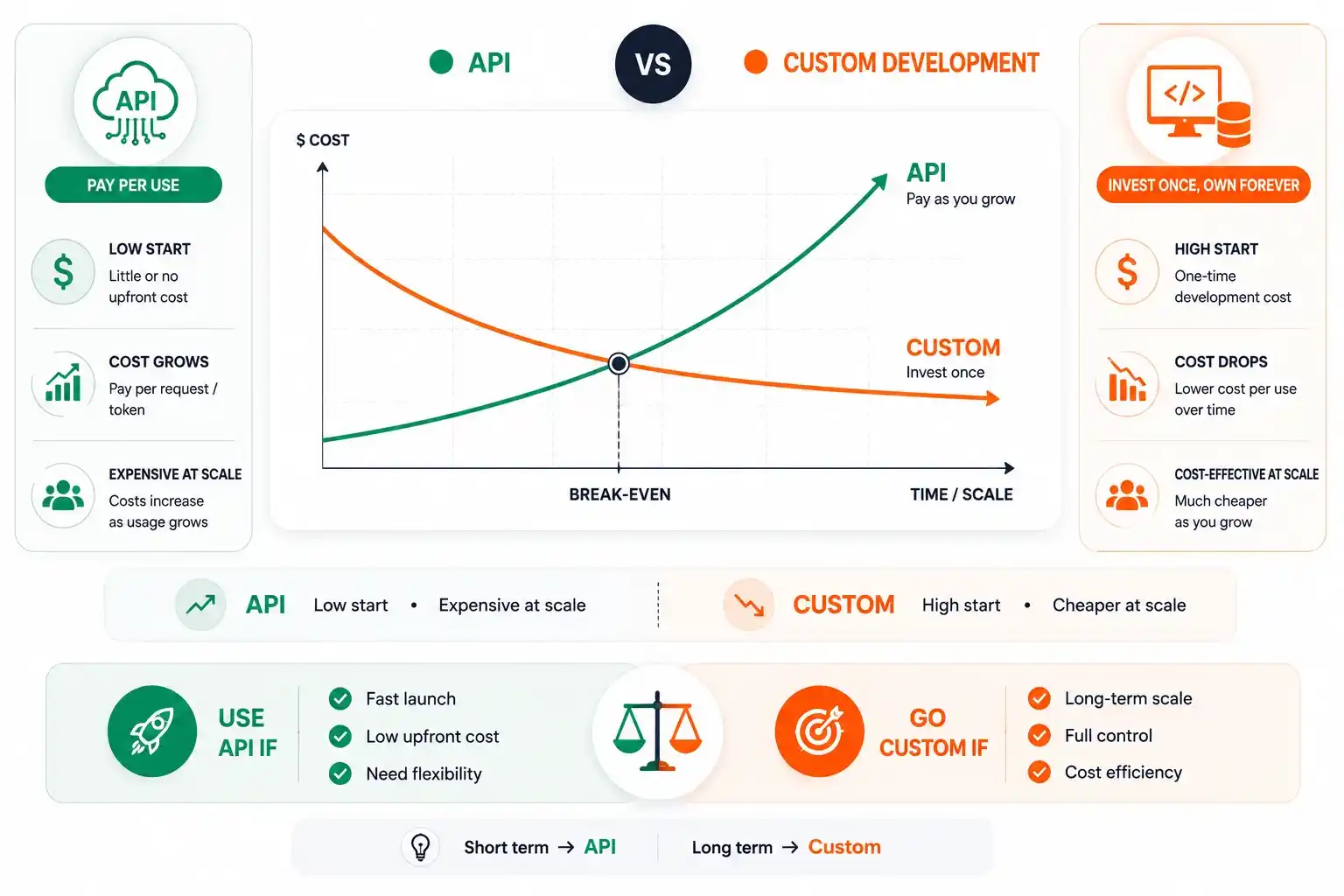
One of the biggest decisions affecting AI app development costs is whether to use an existing AI model through an API or build a custom AI model. The right approach depends on your business goals, budget, data requirements, and long-term scalability. While API-based AI offers faster deployment and lower upfront costs, custom AI provides greater control and flexibility at a significantly higher investment.
API-Based AI
Many businesses build AI applications using commercial AI models accessed through APIs. This approach allows developers to integrate advanced AI capabilities without the time and expense of training a model from scratch. It is often the most cost-effective option for startups and businesses launching their first AI-powered application.
Benefits include:
- Faster deployment
- Lower upfront investment
- Continuous model improvements
- Reduced infrastructure management
However, API providers typically charge based on usage, meaning costs increase as the number of users, requests, or generated content grows. Businesses should include these recurring expenses when estimating long-term operating costs.
Custom AI Models
Some organizations require AI models that are trained or developed specifically for their business. Custom AI is commonly used when companies need unique capabilities, greater control over data, or compliance with strict industry regulations.
Common reasons include:
- Sensitive business data
- Industry regulations
- Domain-specific intelligence
- Competitive differentiation
Developing a custom AI model requires significant investment in collecting high-quality data, model training, testing, infrastructure, and continuous optimization. Although the upfront cost is much higher, it can provide long-term competitive advantages for businesses with highly specialized requirements.
API-Based AI vs Custom AI Models
| Feature | API-Based AI | Custom AI Models |
|---|---|---|
| Upfront Cost | Lower | Higher |
| Development Time | Faster | Longer |
| Maintenance | Minimal | Ongoing |
| Infrastructure | Managed by provider | Self-managed |
| Customization | Limited | Extensive |
| Best For | Most business applications | Specialized enterprise solutions |
For most businesses, using existing AI models provides the fastest and most cost-effective path to launching an AI application. Custom AI models become worthwhile when organizations require proprietary intelligence, strict data control, or capabilities that existing models cannot deliver.
Hidden Costs Businesses Often Overlook
Many businesses focus on the upfront development cost when planning an AI application. However, launching the software is only the beginning. AI applications require ongoing investment in infrastructure, maintenance, monitoring, and model updates to remain secure, accurate, and reliable over time.
| Cost Category | Why It Matters |
|---|---|
| Cloud Infrastructure | AI workloads require computing resources |
| API Usage | Most AI providers charge per request |
| Security Updates | Protect business and customer data |
| Model Improvements | AI performance evolves over time |
| Monitoring | Detect errors and optimize results |
| Compliance | Meet changing regulations |
The importance of each cost category depends on the size and complexity of the application. For example, an AI chatbot serving hundreds of users may have relatively low operating costs, while an enterprise platform processing millions of requests each month requires significantly larger investments in cloud infrastructure, monitoring, and AI API usage.
Typical Ongoing AI Operating Costs
| Expense | Typical Cost |
|---|---|
| AI API Usage | Usage-based (varies by provider and traffic) |
| Cloud Infrastructure | Depends on storage, compute, and scaling needs |
| Monitoring & Logging | Ongoing monthly expense |
| Security Maintenance | Regular updates and security audits |
| AI Model Improvements | Periodic optimization and retraining |
Including these operational expenses in your budget helps create more accurate cost estimates and prevents unexpected financial challenges after deployment. Businesses that plan for long-term maintenance are better positioned to scale their AI applications successfully.
How to Reduce AI App Development Costs
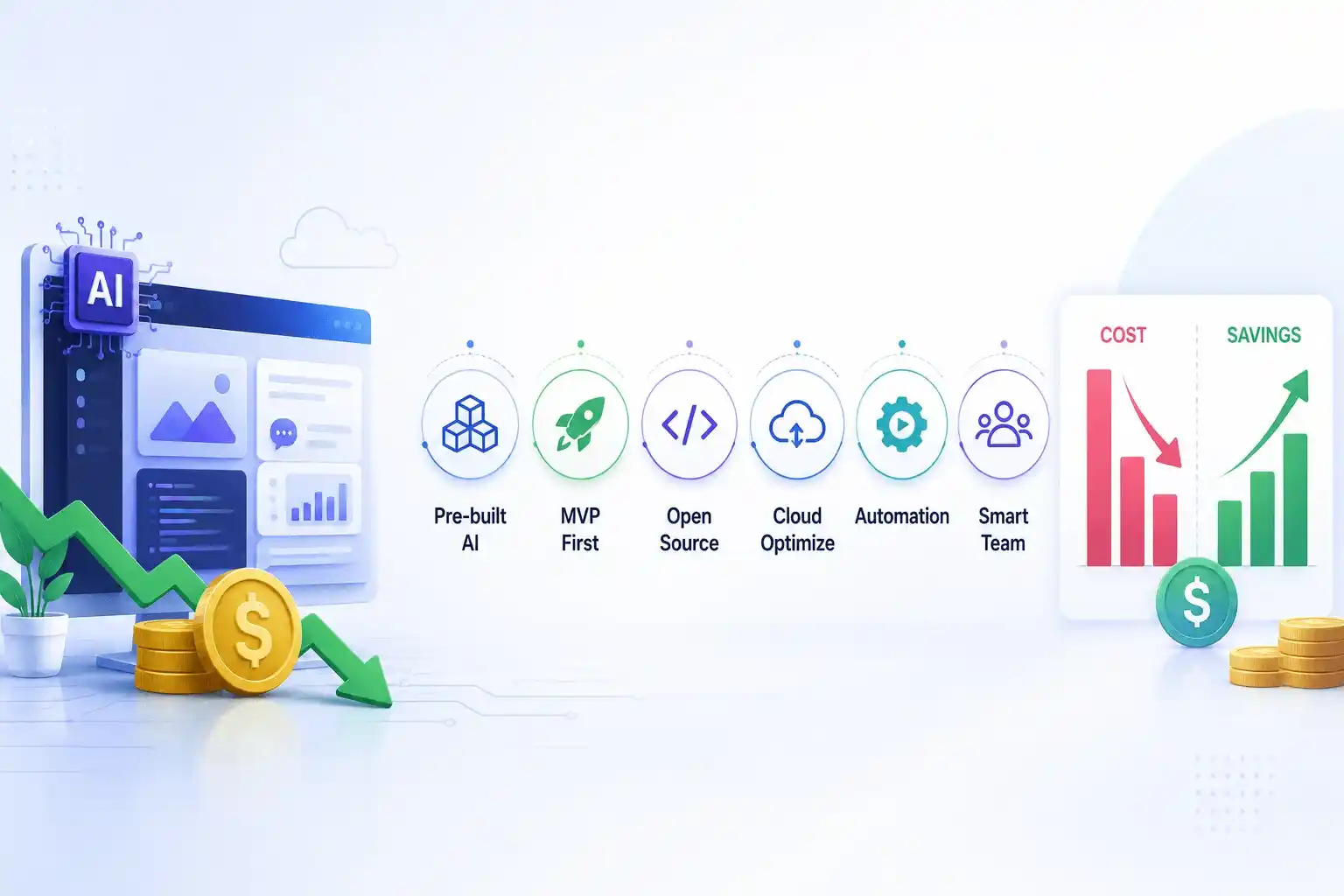
Reducing AI app development costs doesn't mean cutting corners or removing essential functionality. Instead, businesses should focus on strategic planning, prioritizing the right features, and making technology decisions that deliver the greatest value while avoiding unnecessary development expenses.
Build an MVP First
Start with a Minimum Viable Product (MVP) that includes only the core features needed to solve your primary business problem. Launching an MVP allows you to validate demand, collect user feedback, and improve the application before investing in advanced AI capabilities or enterprise-scale functionality.
Reuse Existing AI Models
Use proven AI models and APIs whenever they meet your business requirements. Existing AI services significantly reduce development time, infrastructure costs, and maintenance compared to building and training a custom AI model from scratch.
Prioritize High-Impact Features
Focus your budget on the features that provide the greatest business value. Rather than building every requested feature before launch, prioritize the functionality that directly improves customer experience, productivity, or revenue, and introduce additional capabilities in future updates.
Plan Integrations Early
Identify all required integrations during the planning stage. Connecting CRMs, ERPs, payment gateways, or other business systems early in the project reduces costly redesigns, minimizes technical risks, and helps development stay on schedule.
Work With Experienced Specialists
Partnering with an experienced AI development company helps businesses make informed technology decisions from the start. Experienced specialists can recommend the right AI architecture, identify technical risks early, optimize development costs, and reduce the likelihood of expensive revisions later in the project.
Define Clear Project Requirements
Clearly documenting your business objectives, required features, user workflows, and success metrics before development begins helps prevent scope changes later. Well-defined requirements reduce misunderstandings, improve project estimates, and minimize costly revisions during development.
The most successful AI projects are not always the ones with the largest budgets—they are the ones with clearly defined goals and a phased development strategy. Investing in the right features first often delivers a better return on investment than building a complex solution from day one.
Cost-Saving Strategy vs Benefit
| Strategy | Primary Benefit |
|---|---|
| Build an MVP | Lower initial investment |
| Reuse Existing AI Models | Faster development |
| Prioritize High-Impact Features | Better ROI |
| Plan Integrations Early | Fewer project delays |
| Work With Experienced Specialists | Reduced technical risks |
| Define Clear Requirements | Fewer costly revisions |
Build or Buy AI?
Not every business needs a fully custom AI application. In many cases, purchasing an existing AI solution or using AI-powered software can solve common business challenges more quickly and at a lower cost. However, organizations with unique workflows or long-term strategic goals often benefit from custom AI development.
| Build AI | Buy AI |
|---|---|
| Custom workflows | Standard business needs |
| Full ownership | Subscription-based solution |
| Competitive differentiation | Faster implementation |
| Unique intellectual property | Lower initial investment |
| Unlimited customization | Limited customization |
| Scales with business | Vendor-controlled updates |
| Higher upfront investment | Lower maintenance responsibility |
Which Option Is Right for You?
For businesses seeking long-term competitive advantages, greater flexibility, and complete ownership of their technology, custom AI development is often the better long-term investment despite the higher initial cost.
Choosing the Right AI Development Company
Choosing the right AI development partner is just as important as defining your project requirements. While pricing matters, experience, technical expertise, and long-term support often have a much greater impact on the success of an AI project.
When evaluating providers, ask:
- Have they built similar AI products?
- Do they understand your industry?
- Can they explain the architecture clearly?
- What security practices do they follow?
- How do they handle AI governance?
- Will they provide post-launch support?
- Can they scale the application later?
Red Flags to Watch For
Be cautious of providers who:
- Promise unrealistically short delivery timelines.
- Offer fixed pricing without understanding your requirements.
- Cannot clearly explain their AI architecture or technology choices.
- Lack experience with AI projects similar to yours.
- Do not provide post-launch maintenance or support.
The right AI development company should focus on solving business problems rather than simply implementing technology. A strategic partner will help define requirements, recommend the most suitable AI approach, manage technical risks, and support your application long after launch.
Why Businesses Partner With Maxcode IT Solutions
Building AI software requires more than integrating an AI model.
It requires thoughtful architecture, scalable development, secure integrations, and measurable business value.
At Maxcode IT Solutions, we help businesses transform AI ideas into scalable, production-ready applications. Our team works closely with clients to understand their goals, recommend the right AI technologies, and develop secure, high-performance solutions that deliver measurable business value.
Our expertise spans custom AI software development, AI-powered web applications, AI integration services, AI SaaS platforms, workflow automation, and generative AI solutions tailored to business requirements.
Our AI development process covers discovery, solution architecture, UI/UX design, AI integration, development, testing, deployment, and ongoing optimization to ensure every solution is scalable and future-ready.
Whether you're validating an AI startup idea with an MVP or building an enterprise-scale AI platform, our team focuses on creating secure, scalable, and future-ready applications that continue delivering value as your business grows.
Final Thoughts
The cost of building an AI-powered application depends on far more than coding hours. Business goals, AI capabilities, integrations, security, and scalability all shape the final investment.
Rather than choosing the lowest development quote, focus on long-term business value. Investing in the right architecture, scalable technology, and experienced development partners can reduce maintenance costs, improve user adoption, and deliver a stronger return on investment over the life of the application.
If you're planning an AI application in 2026, begin with a discovery and planning phase before committing to development. Clearly defining your business objectives, AI requirements, integrations, and budget helps create more accurate cost estimates and lays the foundation for a successful AI solution.
Working with an experienced AI development company can help you reduce technical risks, control costs, and build an AI application that continues delivering value as your business grows.
Final Takeaway
The most successful AI projects are not always the most expensive—they are the ones with clearly defined objectives, the right technology choices, and a phased development strategy.
Frequently Asked Questions
How much does AI app development cost in 2026?
Most AI applications cost between $30,000 and $500,000+, depending on complexity, integrations, infrastructure, and AI capabilities.
What is the biggest cost factor?
Project complexity is the biggest cost factor. The number of AI features, custom model development, third-party integrations, data preparation, security requirements, and compliance needs all influence the final development cost.
Is using ChatGPT API cheaper than building custom AI?
In most cases, yes. Using an existing AI API significantly reduces upfront development costs because businesses don't need to train or maintain their own AI model. However, API usage creates ongoing operational costs based on the number of requests and users.
How long does AI app development take?
Simple AI applications often take two to three months. Enterprise platforms may require eight to twelve months or longer.
Should startups build custom AI?
Most startups benefit from launching an MVP using existing AI models before investing in custom AI development. This approach reduces initial costs, speeds up time to market, and allows businesses to validate demand before making larger investments.
Can AI applications scale later?
Yes. A well-designed AI application can scale by adding new features, supporting more users, integrating additional business systems, and adopting more advanced AI capabilities as business requirements evolve.
How much does AI integration cost?
AI integration costs vary depending on the number of systems involved, the complexity of the APIs, and data synchronization requirements. Simple integrations may require minimal effort, while enterprise integrations involving CRM, ERP, or legacy systems can significantly increase project costs.
How much does AI app maintenance cost?
AI applications require ongoing maintenance, including cloud infrastructure, API usage, monitoring, security updates, bug fixes, and periodic AI model improvements. Businesses should budget for these operational costs after deployment.
Can I build an AI MVP for under $50,000?
Yes, many AI MVPs can be developed for under $50,000 when they focus on a specific business problem and use existing AI models rather than custom-trained solutions. The final cost depends on the required features, integrations, and application complexity.
What industries benefit most from AI applications?
AI applications deliver value across industries including healthcare, finance, retail, manufacturing, logistics, customer service, education, and professional services. The specific use case and business objectives determine the overall return on investment.
Is custom AI worth the investment?
Custom AI is worthwhile when businesses require proprietary capabilities, specialized workflows, or strict data control that existing AI models cannot provide. For many organizations, however, API-based AI offers a faster and more cost-effective starting point.
What information should I prepare before requesting an AI development estimate?
Before requesting a quote, define your business goals, target users, required AI features, preferred platforms, integration requirements, security expectations, and project timeline. Providing this information helps development teams deliver more accurate cost estimates.
Author:

By day, Naina Veerwani wrangles tech trends and leads the charge as CXO at Maxcode IT Solutions Pvt. Ltd with her eight years of industry experience. By night (or whenever inspiration strikes!), she transforms into a content-crafting ninja, crafting insightful blog posts to feed your tech knowledge appetite. When she's not wielding words, you can find her obsessing over the latest tech breakthroughs and social media trends or sometimes over tasty food.