
Your vocation, our passion
We are your one stop creative agency providing
Business IT Services.
Top Notch Digital Marketing Agency that drives revenue
and propel your business to new heights.
We create value for industries like Fin-tech |
Healthcare | Ed-tech | Beauty | Travel | E-commerce
and more.
AI Agent Development: The Complete Guide for Businesses in 2026
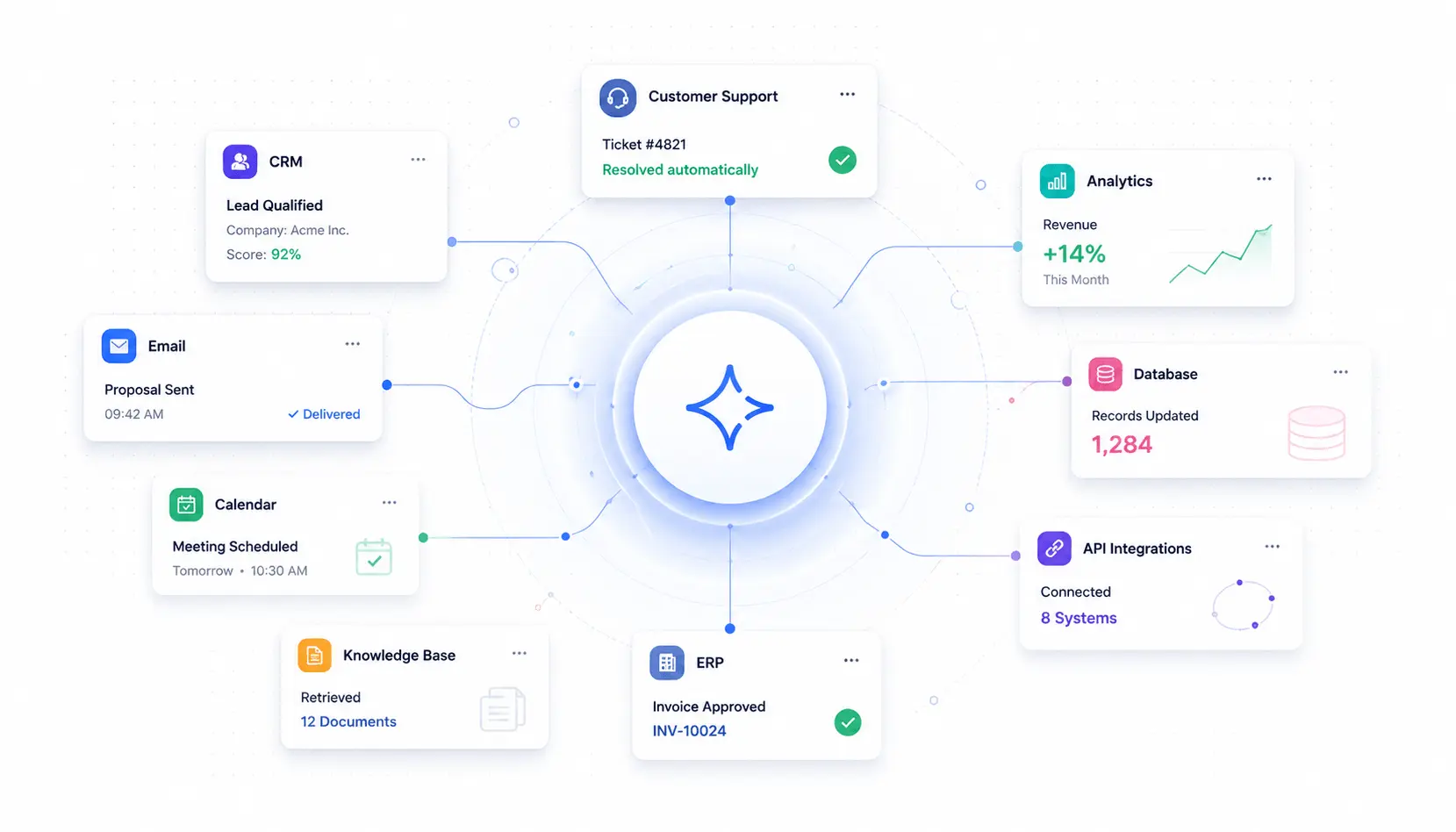
Artificial intelligence has moved beyond chatbots. Businesses now want AI systems that can reason, make decisions, automate workflows, and complete tasks with minimal human input. That is where AI agent development comes in.
Whether you want to automate customer support, streamline operations, improve sales, or build AI-powered SaaS products, AI agents can create measurable business value when developed correctly.
This guide explains what AI agent development is, how it works, when businesses should invest, and how to choose the right development partner.
AI agent development is the process of building intelligent software agents that understand goals, analyze information, make decisions, interact with business systems, and execute tasks autonomously. Businesses use AI agents to improve productivity, automate workflows, reduce operational costs, and enhance customer experiences.
What Is AI Agent Development?
AI agent development is the process of designing, building, training, integrating, and deploying intelligent software agents that can independently perform business tasks.
Unlike rule-based automation, AI agents understand objectives, evaluate available information, decide the next action, and complete workflows across multiple systems.
A business AI agent may:
- Answer customer questions
- Schedule meetings
- Generate reports
- Analyze large datasets
- Manage internal workflows
- Update CRM records
- Trigger business processes
- Assist employees with daily tasks
Modern AI agents combine large language models (LLMs), APIs, business logic, memory, and enterprise integrations into a single intelligent system.
Companies see the highest ROI when AI agents automate complete business workflows instead of isolated tasks.
Why Businesses Are Investing in AI Agents
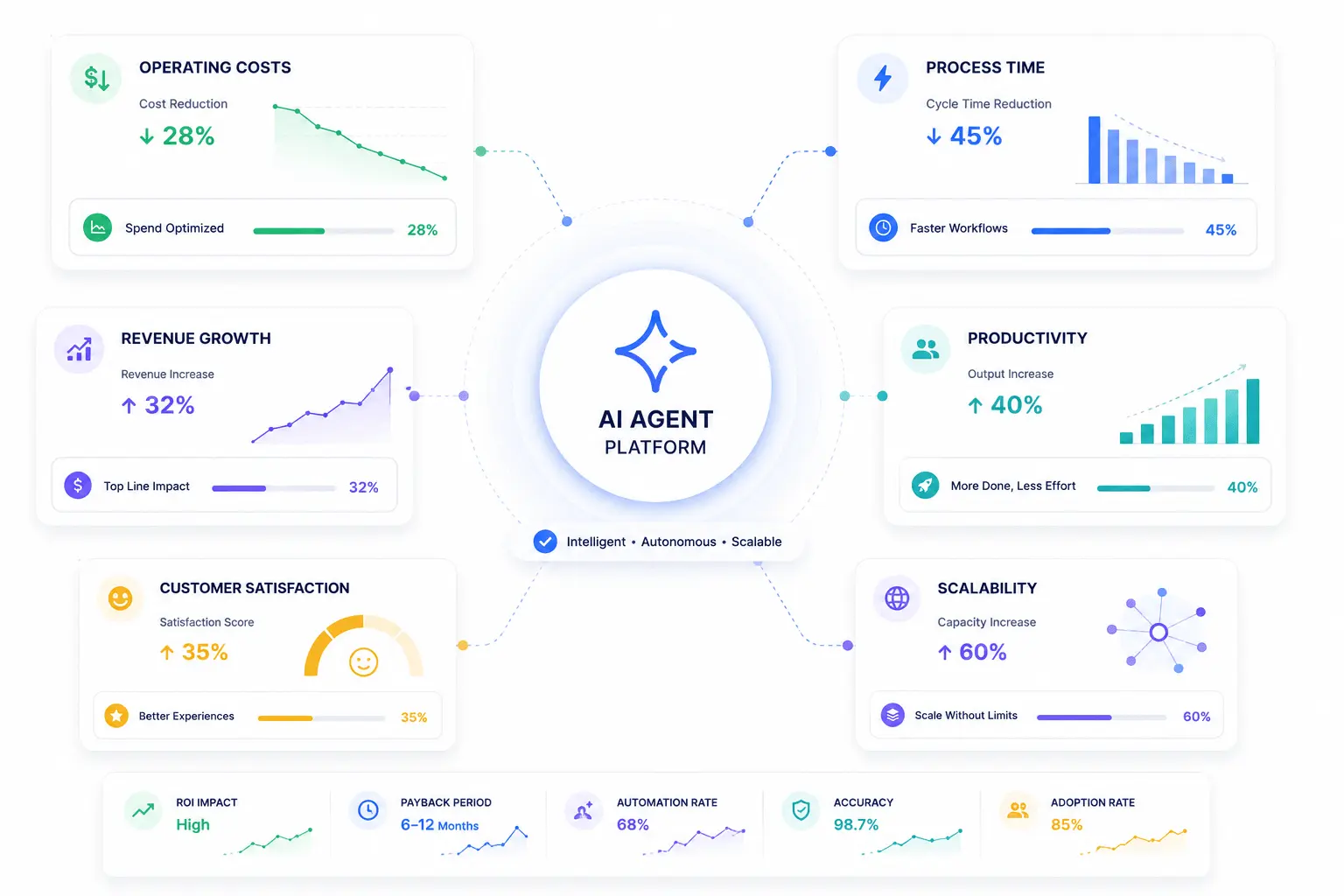
Organizations are no longer looking for AI just to answer questions. They want AI that performs work.
Here are the biggest business drivers.
| Business Goal | How AI Agents Help |
|---|---|
| Reduce operating costs | Automate repetitive work |
| Improve customer experience | Deliver instant, personalized responses |
| Increase productivity | Complete tasks without manual intervention |
| Scale operations | Handle growing workloads efficiently |
| Better decision-making | Analyze business data in real time |
| Faster internal processes | Connect multiple business systems automatically |
Businesses across healthcare, finance, manufacturing, logistics, retail, SaaS, education, and professional services are investing in AI agents to automate repetitive work, improve customer experiences, and increase operational efficiency.
How AI Agents Work
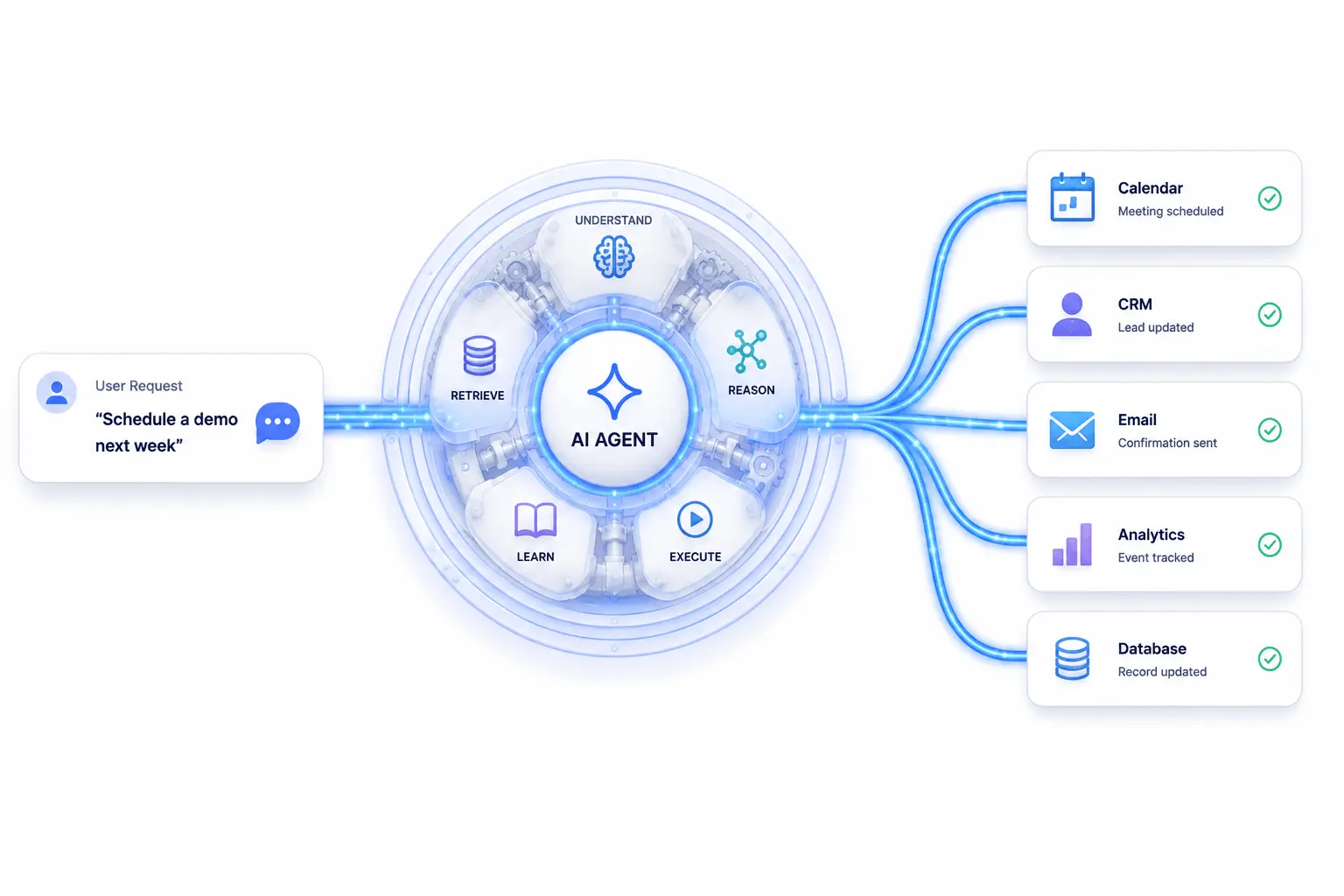
An AI agent follows a structured workflow instead of simply generating text.
Step 1: Understand the Goal
The agent receives a business objective or user request.
Step 2: Gather Information
It retrieves relevant data from internal systems, APIs, documents, databases, or cloud platforms.
Step 3: Analyze Context
The AI evaluates available information before selecting the next action.
Step 4: Execute Tasks
The agent performs approved actions such as sending emails, updating CRM records, generating reports, or processing requests.
Step 5: Learn and Improve
Many enterprise AI agents continuously improve using feedback, historical interactions, and business rules.
Types of AI Agents Businesses Build
Different business goals require different AI agents. The right AI agent architecture depends on the tasks it needs to perform, the systems it must integrate with, and the level of autonomy required.
| AI Agent Type | Primary Business Use |
|---|---|
| Customer Support Agent | 24/7 customer assistance |
| Sales Agent | Lead qualification and follow-ups |
| Internal Operations Agent | Workflow automation |
| HR Agent | Employee onboarding and HR support |
| Finance Agent | Invoice processing and reporting |
| Knowledge Agent | Enterprise search and document retrieval |
| SaaS AI Agent | AI-powered software products |
| Multi-Agent System | Complex enterprise workflows |
An experienced AI agent development company helps design the right AI architecture based on business objectives, integration requirements, and long-term scalability.
AI Agent Development Process
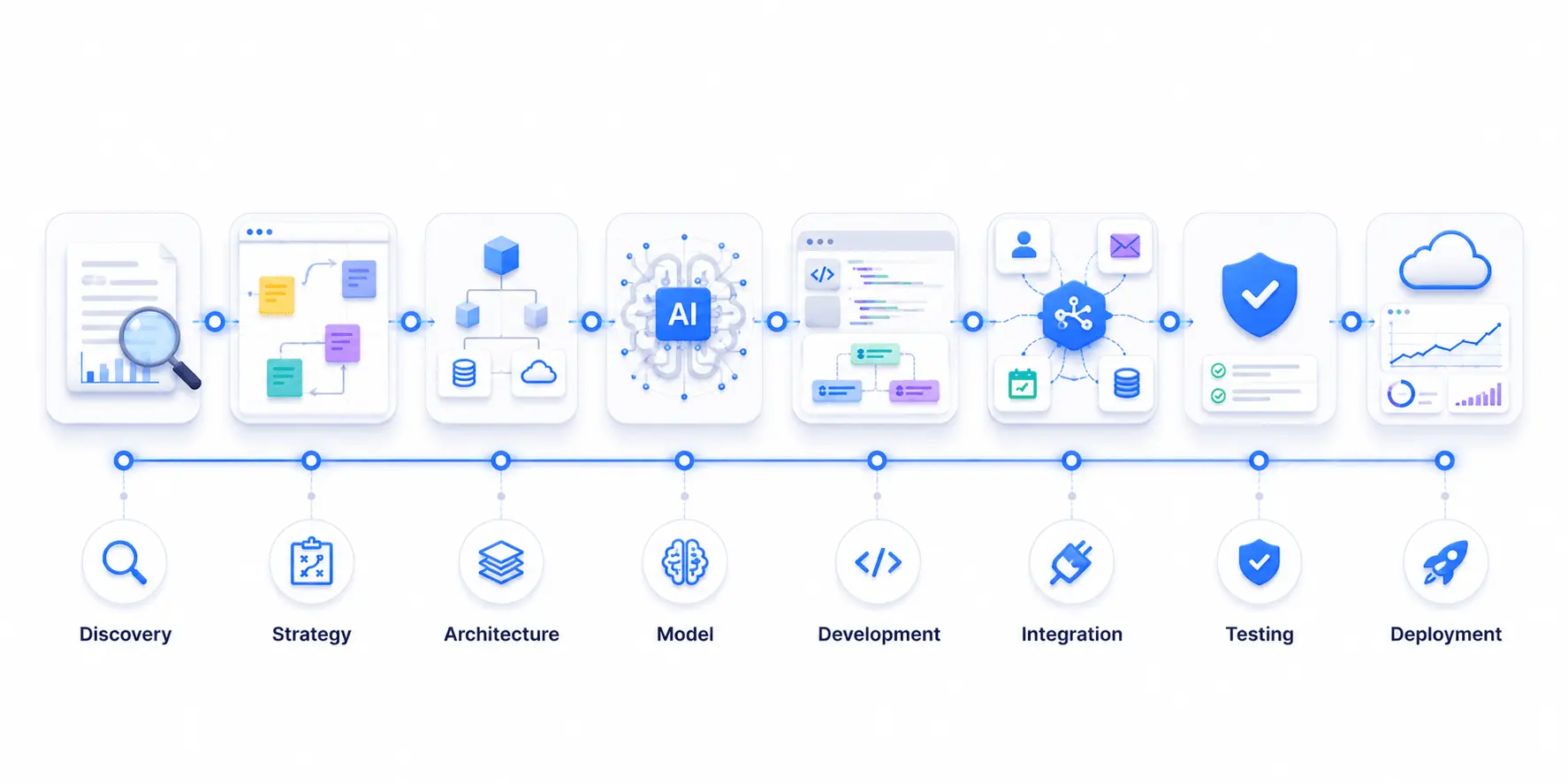
Successful AI implementation follows a structured development lifecycle.
1. Business Discovery
Identify business problems worth automating.
2. Define AI Strategy
Define measurable outcomes, KPIs, integrations, and security requirements.
This stage often involves AI consulting services to evaluate technical feasibility.
3. Design Solution Architecture
Design the AI workflow, data pipeline, APIs, and infrastructure.
4. Select AI Models
Choose the most suitable AI models based on performance, cost, and privacy requirements.
5. Develop the AI Agent
Develop the AI agent using custom AI software development practices tailored to business requirements.
6. Integrate Enterprise Systems
Connect the AI agent with CRM, ERP, databases, cloud platforms, communication tools, and internal applications.
This is where AI implementation services for enterprises become critical.
7. Test Performance and Security
Validate security, accuracy, scalability, and business performance before deployment.
8. Deploy and Optimize
Monitor usage, collect feedback, optimize prompts, and improve workflows continuously.
AI Agent Development Cost
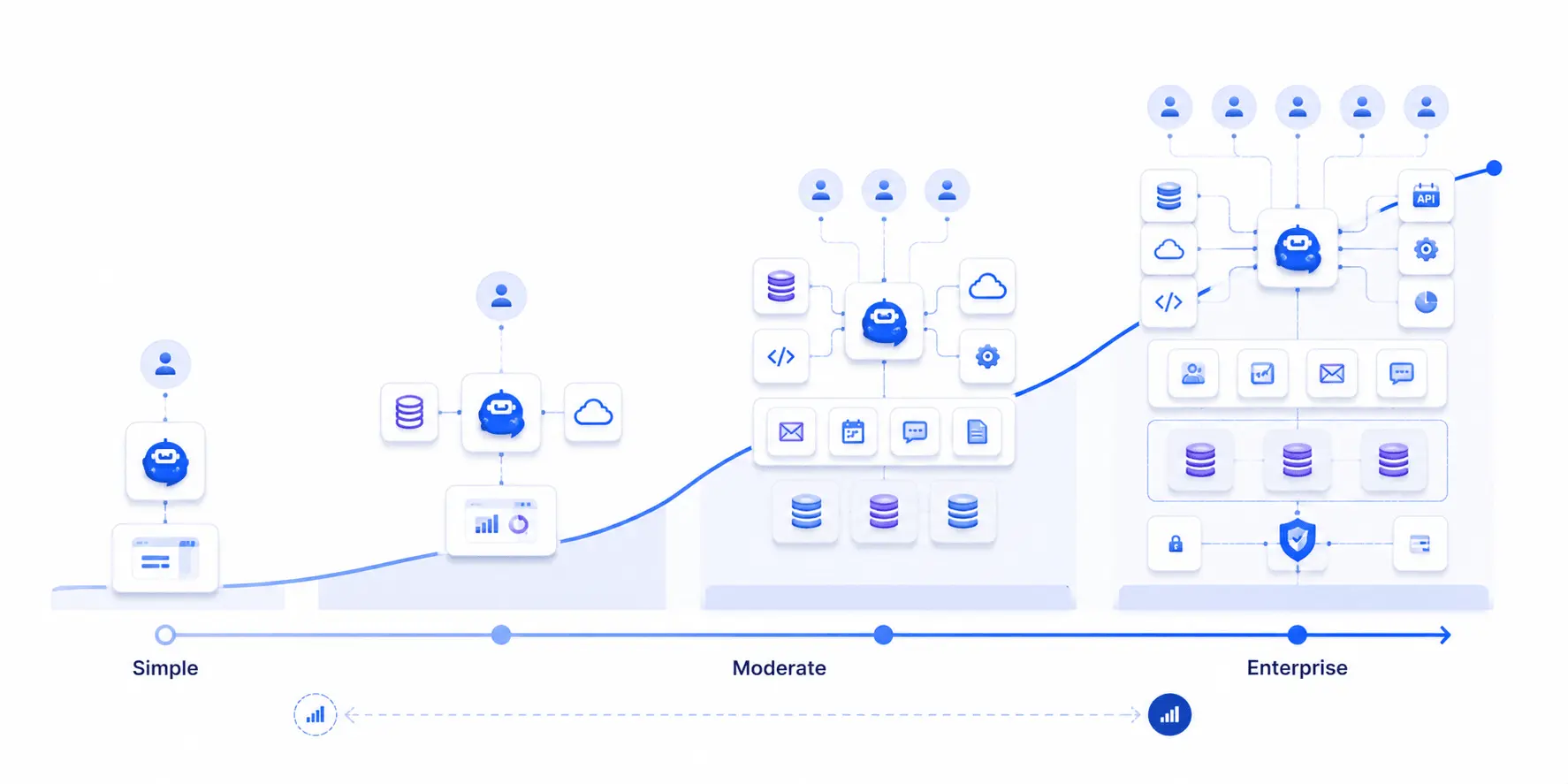
One of the most common questions businesses ask is, "How much does AI agent development cost?" The answer depends on the complexity of the solution, the number of business systems involved, security requirements, and the level of customization. A simple internal AI assistant requires significantly less development effort than an enterprise AI platform that integrates with multiple business applications and automates complex workflows.
Because every business has different requirements, AI agent projects are typically estimated based on implementation scope rather than fixed pricing.
| Project Type | Typical Development Timeline |
|---|---|
| Simple internal AI assistant | 3–6 weeks |
| Customer support AI agent | 6–10 weeks |
| Sales automation agent | 8–12 weeks |
| Enterprise AI platform | 3–9 months |
The overall investment depends on several technical and business factors, including:
Integration Requirements
AI agents often need to connect with existing systems such as CRM platforms, ERP software, help desk solutions, email services, cloud storage, and internal databases. The more systems that require integration, the more development, testing, and maintenance effort is involved.
Custom Business Workflows
An AI agent designed around your organization's unique approval processes, customer journeys, or operational workflows requires more planning and development than a generic AI assistant. Highly customized workflows generally provide greater long-term business value because they align closely with existing operations.
Knowledge Base and Retrieval (RAG)
Enterprise AI agents often use Retrieval-Augmented Generation (RAG) to retrieve relevant information from company documents, knowledge bases, or internal databases before generating responses. This improves accuracy and enables the agent to answer using your organization's own information.
Memory and Context Management
AI agents that remember previous conversations, user preferences, or ongoing tasks require additional infrastructure compared to agents that process each request independently.
Security and Compliance
Security requirements such as encryption, access controls, audit logs, private deployments, and regulatory compliance can significantly affect both development effort and deployment planning.
Multi-Agent Systems
Projects involving multiple AI agents that collaborate across different workflows require more sophisticated architecture than single-agent solutions, increasing development complexity.
Common Business Use Cases
Businesses rarely build AI agents just to replace chatbots.
Instead, they automate high-value processes.
Customer Service
- Ticket resolution
- Intelligent escalation
- Personalized support
- Self-service automation
Sales
- Lead qualification
- Meeting scheduling
- Proposal generation
- CRM updates
Marketing
- Content generation
- Campaign optimization
- Customer segmentation
- Performance reporting
Operations
- Workflow automation
- Inventory monitoring
- Internal approvals
- Task coordination
Finance
- Invoice processing
- Financial reporting
- Compliance checks
- Expense validation
Human Resources
- Employee onboarding
- Policy assistance
- Resume screening
- Internal knowledge support
Many organizations also combine generative AI development with intelligent agents to automate content creation, documentation, and enterprise knowledge management.
AI Agent Development vs AI Chatbots
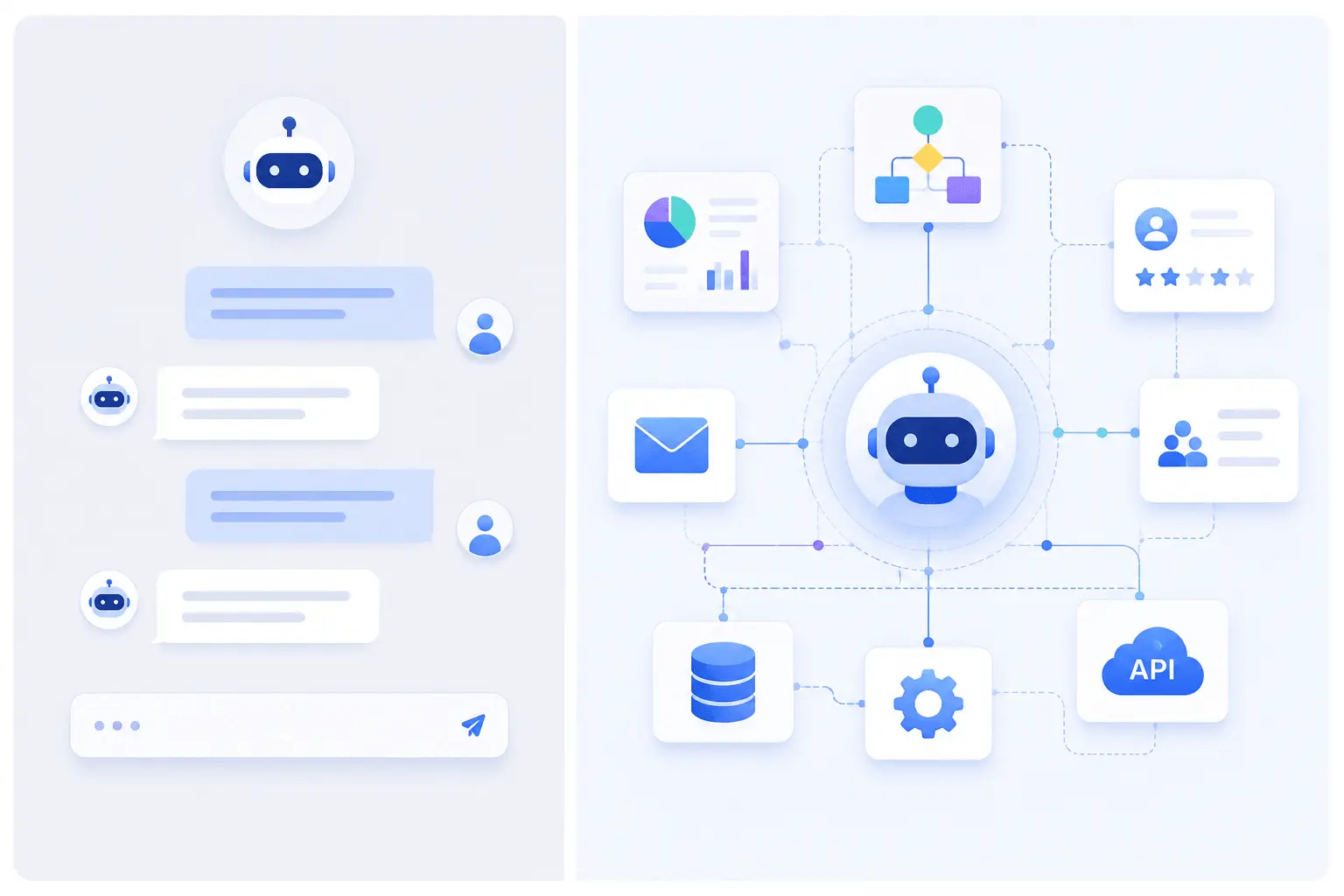
Although the terms AI chatbot and AI agent are often used interchangeably, they serve different purposes. Chatbots primarily answer questions and hold conversations, while AI agents can make decisions, interact with business systems, and complete multi-step workflows with minimal human intervention.
| AI Chatbot | AI Agent |
|---|---|
| Answers questions | Completes tasks |
| Conversation focused | Goal focused |
| Limited actions | Multi-step workflows |
| Minimal integrations | Deep business integrations |
Businesses looking to automate complete workflows typically benefit more from AI agents than traditional AI chatbots.
AI Agent Development vs Traditional Automation
Businesses often confuse AI agents with standard automation tools.
| Traditional Automation | AI Agent Development |
|---|---|
| Rule-based | Goal-based |
| Static workflows | Dynamic decision-making |
| Limited flexibility | Context-aware reasoning |
| Requires predefined rules | Learns from context |
| Handles repetitive tasks | Handles complex workflows |
| Minimal adaptation | Continuous improvement |
For businesses managing changing workflows, AI agents provide greater flexibility than traditional automation.
Choosing the Right AI Development Company
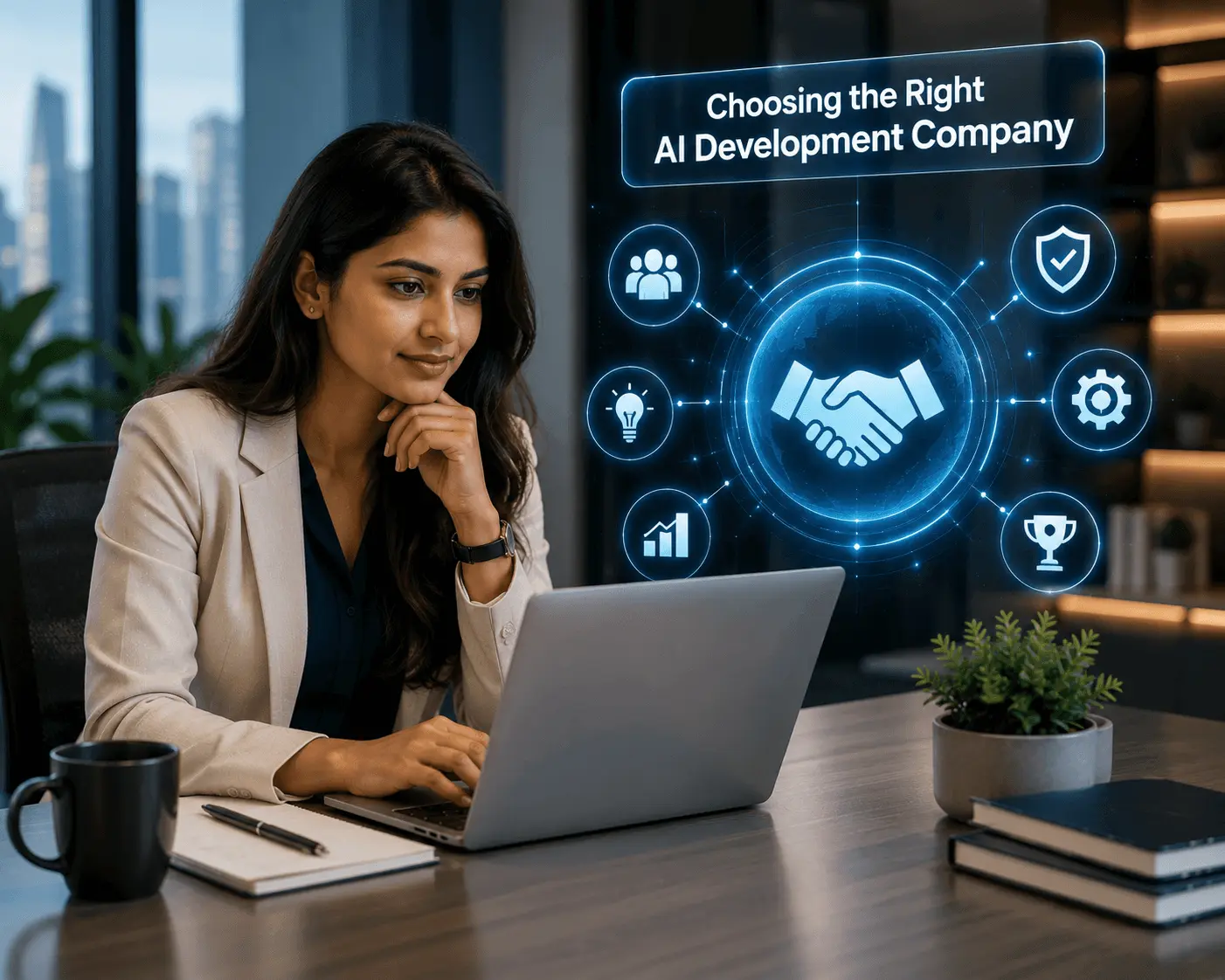
Not every software vendor specializes in enterprise AI.
Before selecting an AI development company, evaluate these areas.
AI Strategy Experience
The partner should understand business transformation, not just software development.
Custom Development Capability
Avoid one-size-fits-all solutions.
Look for expertise in custom AI software development.
Enterprise Integration
Your AI should work with existing systems instead of replacing them.
Security and Compliance
Ask about data privacy, governance, encryption, and regulatory compliance.
Long-Term Support
AI systems require ongoing optimization after deployment.
A reliable AI SaaS development company also supports continuous improvement, model updates, and scalability.
Enterprise AI projects typically require expertise in AI strategy, solution architecture, workflow automation, enterprise integration, security, and ongoing optimization. Partnering with an experienced AI development company helps reduce implementation risks and supports long-term scalability.
Key Questions Before Starting an AI Project
Before investing in AI, business leaders should answer these questions.
- Which workflows create the biggest operational bottlenecks?
- Which business systems need AI integration?
- What data will the AI agent access?
- How will success be measured?
- What security requirements exist?
- Should the solution use cloud, private infrastructure, or hybrid deployment?
- Will future expansion require multiple AI agents?
Answering these questions early reduces implementation risks and accelerates ROI.
Conclusion
AI agent development is quickly becoming a competitive necessity rather than an experimental technology.
Businesses that invest early gain faster operations, improved customer experiences, and better decision-making across departments.
However, long-term success depends on selecting the right strategy, identifying high-value workflows, and partnering with an experienced AI development company that can deliver secure, scalable, and customized solutions.
Whether you plan to automate internal operations, improve customer experiences, or build AI-powered products, investing in a well-designed AI agent can deliver long-term business value. Working with an experienced AI development company helps ensure your solution is secure, scalable, and aligned with your business objectives.
Frequently Asked Questions
What is AI agent development?
AI agent development is the process of creating intelligent software that can analyze information, make decisions, and complete business tasks with minimal human involvement.
How is an AI agent different from a chatbot?
A chatbot mainly answers questions. An AI agent can complete multi-step tasks, interact with business systems, and automate workflows independently.
Which industries benefit the most from AI agents?
Healthcare, finance, logistics, manufacturing, retail, SaaS, education, insurance, and professional services all benefit from AI agent implementation.
How long does AI agent development take?
The timeline depends on project complexity, integrations, business requirements, and testing. Simple solutions may take weeks, while enterprise implementations require several months.
Should businesses build custom AI agents?
Yes. Custom AI software development allows organizations to align AI capabilities with existing workflows, security requirements, and long-term business goals.
When should I hire an AI development company?
Businesses should work with an experienced AI partner when projects involve enterprise integrations, custom workflows, data security, or large-scale AI implementation.
How much does AI agent development cost?
The cost of AI agent development depends on the complexity of the solution, required integrations, security requirements, and level of customization. Simple internal AI assistants typically require less development effort than enterprise AI platforms designed to automate complex workflows across multiple business systems.
Author:

By day, Naina Veerwani wrangles tech trends and leads the charge as CXO at Maxcode IT Solutions Pvt. Ltd with her eight years of industry experience. By night (or whenever inspiration strikes!), she transforms into a content-crafting ninja, crafting insightful blog posts to feed your tech knowledge appetite. When she's not wielding words, you can find her obsessing over the latest tech breakthroughs and social media trends or sometimes over tasty food.